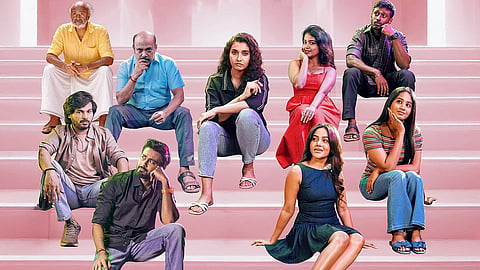

Memes are more than just ready-made jokes. They are mass-produced units of expression. Do you want to convey your thoughts on something? Memes are the way. While movies have been the fountainhead of memes, Hot Spot 2 Much makes you stop and wonder if memes have already become their own genre. I don’t mean that the anthology provides infinite “meme material”, even though it might and it also flashes actual memes on the screen. What I mean, instead, is that the film leans hard on the DNA of memes to create direct, conspicuous units of self-expression. You want to show how ridiculous your fanboy friend looks like defending his star idol? There are two varieties played by Rakshan and Aadhitya Baaskar. Do you scoff at new-age dating terminologies? There is an entire montage designed to mock “benching” and “LDR”. You think freedom of choice should not overstep our societal norms on “when to wear what”? Thambi Ramaiah gives you an entire monologue. Speaking of which, Hot Spot 2 Much is essentially a collection of Vignesh Karthick’s opinions on contemporary issues, presented in the form of several monologues. These collections of opinions might give you clarity, annoy you, make you feel seen, leave you cringing, deeply resonate with you, or have you raging. All of these are extremely valid feelings to have about its opinions, but as a film itself, Hot Spot 2 Much largely keeps you engaged.
Director: Vignesh Karthick
Cast: Priya Bhavani Shankar, MS Bhaskar, Thambi Ramaiah, Rakshan, Ashwin Kumar, Aadhitya Baaskar, Bhavani Sre
The sequel follows the same structure as the original, with Priya Bhavani Shankar narrating three stories to a producer this time. She dominates her portions with the signature snark of the franchise, which sometimes turns into a condescending tone. The storytelling is simplistic and reductionist. But such a simplistic outlook works wonderfully in the first story, which takes on the toxic fan culture. Massive props to the director for being unsubtle about the portrayal of stars and the depths of depravity that their fans reach to defend and worship them. MS Bhaskar, once again, proves himself as one of the greatest actors in Tamil cinema, delivering an affecting monologue. There is no psychological or sociological dissection of the fan culture, and in cinematic fashion, people change through a single monologue. As mentioned earlier, it is simplistic, and that is perfectly fine because the story presents itself with conviction and touches upon a subject we often shy away from on the big screen, lest we offend someone. The story unravels, and with it, more problems arise.
In the second story, Thambi Ramaiah plays a doting father struggling to accept his daughter's modern values. The director argues that while the daughter (Sanjana Tiwari) is right in choosing to wear modern clothes as a form of self-expression, it is equally valid for the father to wear dirty, torn clothes to her birthday party to point out the irony. The film explains how freedom of expression should be mindful of the setting and social context (“idam porul eval”). The film does a nifty job of portraying patriarchal oppression before making its ultimate point, but it feels more like a calculated manoeuvre to deflect criticism than an open discussion it claims to be. This is evident by how the fiercely opinionated daughter fails to question how the entire point of the liberal outcry against “dress norms” originally sought to restructure these norms (idam porul eval) and not to drown it in vacant chaotic rebellion. There is a subtle dishonesty in how the film equates shorts to old, ragged clothes. The film also pursues this half-baked approach with its commentary on contemporary relationships and the apparent lack of “true love”.
The third story presents the current state of relationships like a dystopian nightmare, with its protagonist reaching into a rosy far future (through a time travel device) to meet a girl from a generation that has “thankfully” regained their touch with “true love”. Hot Spot 2 Much feels like someone redirecting their anxiety about growing old and being out of touch with the times into a desperate critique of the current generation. Apparently, love doesn’t exist anymore because the kids came up with a bunch of different terms to mask their inability to maintain monogamous relationships. The snarky tone is presented through a malicious reading of contemporary relationships and a ridiculously oversimplified theory on the evolution of love.
Taking a leaf out of the film’s meta-ness, it is fun to ponder a scenario where Vignesh Karthick reads this review and goes, “Just because you don’t agree with it doesn’t mean it’s a bad take.” Even if I counter it with “it is not about whether the takes were right or wrong but how undercooked they were,” the director is still in the right. The film is engaging exactly because it operates in this zone of “take it or leave it”. You don’t want to completely take it all, but you’re not leaving in a hurry either. Hot Spot 2 Much is that one friend who you occasionally hang out with, but then they start slipping their wild opinions into the conversation that you’re not so sure about. You still nod and laugh, so they move on. You’re probably not making immediate plans to meet them again, but if they want to catch up later, you would still go just to hear what fresh wild takes they have. I guess we are seated for Hot Spot 3.
