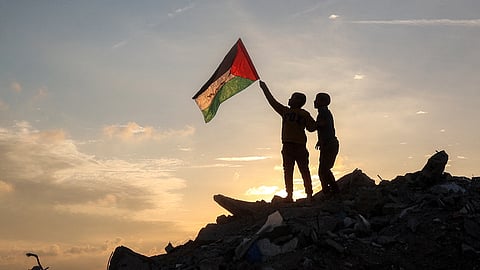

Hours after US President Donald Trump issued an ultimatum to Hamas to accept his ‘peace plan’ before Sunday evening or face extinction, the Gaza-based outfit on Saturday said it was ready to accept some of the 20 points in the proposal, adding the others need negotiations. Trump immediately welcomed the Hamas response and asked Israel to stop its bombing in Gaza, claiming it would usher in lasting peace in the entire West Asian region. The positive messages also rekindled hopes of an early resolution to the Gaza conflict, which many feared was about to get worse in the days to come.
When Trump announced his 20-point peace plan on September 29 to end the bloodshed in Gaza, Israel was already two weeks into its latest military campaign to take over the enclave in a bid to smoke out the 3,000-odd Hamas militants there. With boots on the ground, the Israeli Defense Forces (IDF) had even issued an unprecedented call asking all the civilians in Gaza City to evacuate. As it combed through suspected Hamas hideouts, blowing up the buildings where the militants were believed to be occupying, thousands were forced to flee. According to reports, a few hundred people have been killed in Gaza since the start of Israel’s ground offensive on September 16.
Now, as the second anniversary of the October 7 Hamas massacre nears, hectic efforts are on to force Israel to end its relentless bombing of Gaza and the enclave’s militant outfit to return the Israeli hostages it has been holding for the past two years. The US peace plan, finalised after a meeting between Israeli Prime Minister Benjamin Netanyahu and Trump in the White House, was immediately endorsed by Israel. It was also widely welcomed by the international community, including Arab nations, as a pragmatic proposal to end the mindless violence in Gaza that has killed 67,000 people. With Hamas partially accepting the plan, the ball is now in US and Israel’s court to take it forward.
The Trump plan
Trump’s proposal calls for an immediate ceasefire in Gaza by Israel and release of 48 hostages--20 of whom are believed to be alive--by Hamas. In exchange for the hostages, Israel will free 1,700 Palestinian prisoners. Hamas will also have to give up arms and it can’t be part of Gaza’s future administration. If Hamas accepts the plan, it will get amnesty and safe passage into third countries that are willing to take them.
Under the plan, Israeli forces will withdraw from parts of Gaza Strip in phases. A Board of Peace, led by Trump with other heads of state as members, will set the framework for governance, coordinate funds for reconstruction, and monitor aid flow to ensure they don’t fall prey to radical elements. Under this board, an apolitical committee comprising Palestinian representatives backed by international experts will take care of the day-to-day affairs of public services such as hospitals and schools.
Trump’s plan doesn’t explicitly offer the creation of a Palestinian state as a lasting solution though it offers a pathway leading to it. It says Gaza will be de-radicalised and rebuilt with international aid. Israel will have some say in the security matters.
What exactly Hamas said
For the first time, Hamas has agreed to release all the hostages. The Trump plan says it should be done within 72 hours. On this, Hamas’ response was careful. It said it is ready to release all Israeli prisoners, both living and dead, according to the exchange formula if the “field conditions” for the exchange are met. What those “field conditions” are is unclear though Trump sees a path to end the Israeli military campaign in Gaza.
Hamas has not explicitly agreed to lay down arms or hand over Gaza’s governance to the Trump-led Board of Peace. While it is mum on giving up arms, it says it is ready to pass on the baton to ‘Palestinian experts’, which could create room for further friction with Israel. It also wants to “contribute and take part” in the administration, which is is out of sync with Trump’s formula.
Israel’s position
Soon after Trump announced the proposal, Israeli PM Netanyahu said it’s the best deal Israel could have asked for. He claimed the draft protects Israel’s interests, as it calls for return of all Israeli hostages, demilitarising Hamas, and allowing Israeli forces to stay in most parts of Gaza. Netanyahu also claimed Israel would strongly oppose any move for the creation of a Palestinian state.
While Israel is yet to officially comment on Hamas’ response, reports said Netanyahu expressed ‘surprise’ at Trump’s positive remarks.
At the moment, Israel has troops and tanks on the ground in Gaza and drones and jets in the air. In the initial days of its ground offensive, IDF demolished a few high-rises after asking its residents to evacuate. While the IDF has not officially released full details of its troop deployment, reports indicate that around 45,000 troops are operating in Gaza City and another 30,000 elsewhere in Gaza Strip. Plus, a total of 1.3 lakh reservists—both new and existing — have signed up for the Gaza operation, making the overall troops strength at roughly over 2 lakh. That is a massive build-up to manage 4-5 lakh people currently estimated to be in Gaza City.
In its latest operation, the IDF uses old military vehicles laden with explosives and modified in such a way that they can be controlled remotely. These are driven straight to known Hamas positions and detonated from afar, avoiding casualties on the Israeli side. Israel’s key objective in Gaza is to destroy the underground tunnel network used by Hamas to hide its operatives, and smuggle weapons and supplies. In past operations, Israel tried to find and destroy some of these tunnels. Extreme measures were reportedly used in some cases, such as flooding the tunnels with sea water and chemicals.
Gaza’s future
Israeli forces are still in Gaza and Hamas is divided on laying down arms. However, Israel has instructed its army to advance its preparations for the first phase of Trump’s plan to end the war. Trump is personally invested in the deal as his son-in-law Jared Kushner and US special envoy Steve Witkoff are slated to attend peace talks in Egypt over the weekend. We keep our fingers crossed.
