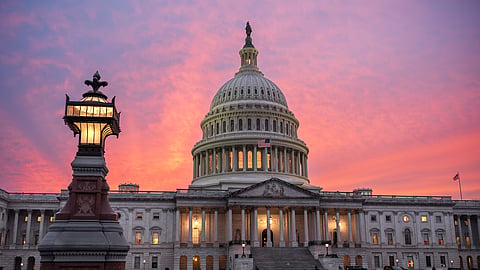

US government shutdown takes place when Congress fails to pass necessary funding legislation, forcing many federal operations to pause. Essential services continue, at times without pay for workers, while non-essential agencies shut down entirely.
The US fiscal year begins on October 1. If legislators can’t pass a budget or a temporary funding measure (known as a continuing resolution) by then, government agencies are legally required to stop non-essential activities. This process isn’t about the government running out of money. Rather it’s about Congress not authorising the spending.
Shutdowns are a product of how the US budgeting system is structured. Since the 1970s, federal law has required all discretionary spending to be authorised by Congress. If lawmakers deadlock over a bill, often due to partisan disagreements, the flow of money comes to a halt. This time around, Democrats are pushing to extend Obamacare tax credits and reverse Medicaid cuts signed by President Trump. Senate Minority Leader Chuck Schumer rues that the Republicans have refused to negotiate, triggering a shutdown. Meanwhile, Republicans are shifting focus to immigration, accusing Democrats of trying to give free healthcare to undocumented immigrants. The Democratic proposal targets provisions in the One Big Beautiful Bill Act that restrict healthcare access for certain immigrants.
Not all government functions cease during a shutdown. Agencies are required to submit contingency plans identifying which functions are “essential” and must continue—though often without pay.
Services typically stopped or slashed
Federal Employees: Around 8,00,000 federal employees may be furloughed (put on unpaid leave) or required to work without pay. During the longest-ever US government shutdown in 2018 and 2019 nearly 800,000 federal employees went without pay for 35 days. Non-essential staff, such as many in regulatory, research, and administrative roles will stay put at their homes. Thousands of contractors who support government agencies don’t get paid and often aren’t eligible for retrospective pay once the shutdown ends. Institutions like the Smithsonian museums and the National Gallery of Art often shut their doors. Federally funded pre-schools such as Head Start may close due to lack of funding. Federal grants and student loan disbursements may be delayed.
Research and Health Agencies: Organisations like the Centers for Disease Control and Prevention (CDC) and the National Institutes of Health (NIH) furlough staff, which can pause research and delay grant reviews. Disease monitoring and outbreak responses may be affected. Delays are expected, particularly if passport agencies are located in federally owned buildings that close. Key economic indicators like the monthly jobs report, published by the Bureau of Labor Statistics, are paused.
What services continue
Despite a shutdown, services deemed “essential for life and property” continue to operate: National Security and Defense -- military personnel stay on duty, although they may not be paid on schedule. Intelligence and counterterrorism activities continue.
Border Protection and Law Enforcement: Customs and Border Protection, Immigration and Customs Enforcement (ICE), FBI, and the Secret Service keep operating. Air traffic controllers and Transportation Security Administration (TSA) workers report for duty. Social security, medicare, benefit checks continue to go out. However, verification services, customer service, and new card issuance may be suspended. The US Postal service operates independently and does not rely on congressional funding—mail continues to be delivered.
Economic impact
The 2018–2019 shutdown, which lasted 35 days — the longest in US history — reduced GDP by $11 billion, with $3 billion permanently lost, as per data from the Congressional Budget Office (CBO).
During shutdowns, federal employees spend less, small businesses that rely on government contracts suffer, and loan processes stall for homebuyers and students. Compliance work by the IRS slows down, meaning tax collections fall behind estimated at $2 billion in lost revenue during the last major shutdown.
Political fallout
While some see shutdowns as a way to force budget discipline or policy changes, the public often views them as evidence of dysfunction. Federal workers go unpaid, while members of Congress still receive their salaries and this draws public criticism.
Historically, both major parties have faced backlash. However, the side perceived as “responsible” for the shutdown tends to take a political hit in opinion polls and elections.
Why shutdowns happen
Shutdowns generally stem from political disagreements. In some cases, one party may use the shutdown threat to demand legislative concessions (like funding for border security or healthcare reforms). For example, the 2018 shutdown began over a funding standoff regarding President Trump’s proposed wall on the Mexico border.
Because the US Senate requires 60 votes to pass most budget-related measures, bipartisan support is often necessary, even if one party controls the House, Senate, and White House. Disagreements over policy riders and non-budget provisions added to bills also cause roadblocks.
Major shutdowns over the years
2018-2019: 35 days; longest shutdown ever; caused flight delays and paused pay for 800,000 workers
2013: 16 days; driven by conflict over the Affordable Care Act (Obamacare)
1995-1996: 21 days under President Bill Clinton over Medicare, education, and the federal budget
1980s: Multiple short shutdowns under President Ronald Reagan’s watch over budget disagreements
Comparison with Indian Parliament
While both the US and India are democracies with bicameral legislatures, there are important differences in structure, function, and how they handle funding crises.
In India, Lok Sabha is more powerful -- budget and money bills must originate here. The Rajya Sabha can delay but not reject them. In the US, both chambers are equal in legislation. Bills can start in either House (except revenue bills, which start in the House). Both must pass the same version for a bill to become law.
Budget and shutdown prevention
In India, the Constitution mandates annual budgets (Union Budget). If not passed before April 1, in the event of an election year, for example, the government can pass a “Vote on Account” to temporarily access funds from the consolidated fund of India. There is no concept of a full government shutdown.
No such temporary mechanism exists by default in the US. Without a passed or extended budget, agencies must cease non-essential operations—resulting in a shutdown. In India, the Prime Minister and cabinet must maintain the confidence of the Lok Sabha. If the government loses a vote of confidence, it can be forced to resign, leading to new elections. But the US has a Presidential system. That means the President remains in office regardless of Congressional control, due to separation of powers. This can cause deadlock if Congress and the President are from opposing parties.
Government shutdowns are an American phenomenon arising from the country’s constitutional structure and political culture. They highlight the deep divides between parties and the procedural rigidity of US budget laws. While India faces its own share of political challenges, its parliamentary structure provides mechanisms to avoid a complete shutdown of government services.
