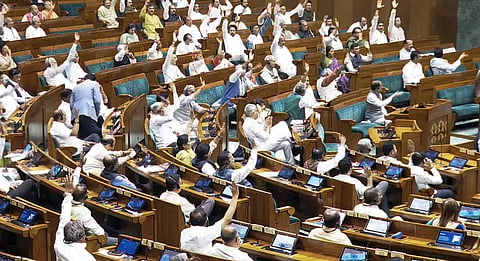

NEW DELHI: Parliament on Monday cleared and introduced key legislations amid persistent protests by the Opposition over the alleged NEET paper leak and the purported theft of donations from the Ram temple in Ayodhya, with repeated sloganeering leaving little room for debate in both Houses.
In the Lok Sabha, the Supreme Court (Number of Judges) Amendment Bill, 2026, which seeks to replace an ordinance increasing the sanctioned strength of the Supreme Court from 34 to 38 judges, including the Chief Justice of India, was passed by a voice vote without discussion.A statutory resolution moved by Opposition members disapproving the promulgation of the ordinance was also rejected by a voice vote.
Union Law Minister Arjun Ram Meghwal briefly introduced the legislation before the Chair invited members to speak on the statutory resolution. However, as Opposition members continued raising slogans over the NEET controversy and allegations relating to Ram temple donations, the Bill was put to vote and passed without debate.
The Indian Statistical Institute Bill, 2026, aimed at overhauling the legal framework governing the Indian Statistical Institute (ISI) and expanding its role as a premier institution for statistical sciences was also introduced in the Lok Sabha by Minister of State Rao Inderjit Singh.
The proposed legislation seeks to repeal the Indian Statistical Institute Act, 1959, and incorporate the ISI as a body corporate with an updated governance structure. It proposes the President of India as the Visitor of the Institute and provides for a Board of Governors as its principal executive body, chaired by an eminent figure from academia, industry, education, public policy or statistical sciences. An Academic Council headed by the Director will oversee academic matters.
Meanwhile, the Rajya Sabha passed the Micro, Small and Medium Enterprises Development (Amendment) Bill, 2026 by voice vote amid sustained Opposition protests.
The legislation seeks to address the longstanding issue of delayed payments to MSMEs by prescribing timelines for dispute resolution and strengthening recovery mechanisms. It empowers courts to direct payment of at least 50 per cent of the awarded amount to MSME suppliers if an application to set aside an order remains pending for more than six months, a provision aimed at easing liquidity constraints faced by small businesses.
Union MSME Minister Jitan Ram Manjhi said the Bill balances the interests of all stakeholders while safeguarding constitutional principles and reaffirmed the government's commitment to strengthening the MSME sector. However, his speech was repeatedly interrupted by sloganeering from Opposition members, who continued demanding Union Home Minister Amit Shah's presence in the House over police action against students protesting the alleged NEET paper leak.
The Rajya Sabha witnessed repeated disruptions from the start of the day. Proceedings were adjourned till 2 pm after Opposition MPs insisted that Leader of the Opposition Mallikarjuna Kharge be allowed to speak.
Chairman CP Radhakrishnan urged members to return to their seats and warned against displaying placards after some Left MPs held up protest signs inside the House. Leader of the House JP Nadda later criticised the Opposition, claiming its members had not even supported amendments moved by their own parties during consideration of the MSME Bill.
