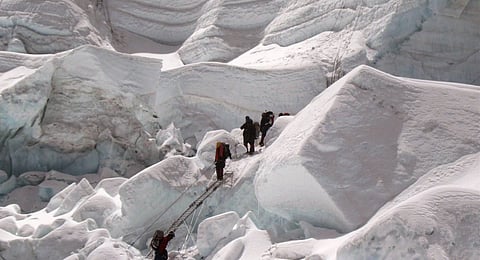

DEHRADUN: Rapid glacier loss driven by global warming could alter stress on Himalayan faults and potentially influence the frequency of earthquakes, preliminary scientific research has suggested, adding a new dimension to climate-related risks facing Uttarakhand and other mountain states.
Scientists, however, caution that a direct causal link between glacier retreat and major earthquakes has not yet been conclusively established.
Several institutions, including Dehradun’s Wadia Institute of Himalayan Geology (WIHG), are studying how changes in ice, rainfall and groundwater affect the tectonically active region.
When glaciers lose vast quantities of ice, the reduced weight on the Earth’s crust causes a redistribution of pressure—a process known as glacial unloading. These stress changes may affect faults that are already strained by tectonic forces and, under certain conditions, trigger minor tremors or influence seismic activity over longer periods.
“Heavy ice loss changes the load on the crust and may generate fresh stress along buried or already strained fault lines,” scientists said. “The process could contribute to small earthquakes and potentially alter the timing of larger events, though more evidence is required.”
Data from the National Centre for Seismology show that Uttarakhand recorded 35 earthquakes between March 1 and August 28, 2026. The tremors occurred across Bageshwar, Almora, Pithoragarh, Rudraprayag, Pauri Garhwal, Chamoli and Uttarkashi districts.
The strongest earthquake during the period, measuring magnitude 3.9, struck Pithoragarh on June 19. Bageshwar recorded a magnitude 3.7 tremor on April 5, while the remaining earthquakes had magnitudes of 3.6 or lower.
Although low-magnitude tremors release some underground strain, scientists say they do not necessarily reduce the threat posed by energy accumulated across the Himalayan “seismic gap”—a section of an active fault that has not produced a major earthquake for a long period.
Researchers are concerned that the Uttarakhand region has not witnessed a major earthquake in nearly two centuries. Considerable tectonic strain may, therefore, have built up underground, though scientists cannot predict when or where it will be released.
WIHG Director Dr Vineet Kumar Gahalaut said climate change was influencing several interconnected natural systems, including the monsoon, sea levels and heatwaves. “All natural processes are interconnected. There are regions, including Greenland, where earthquakes are now being recorded in places that earlier had little such activity. In that context, climate change may also have an impact on seismicity,” Gahalaut said.
Scientists are also examining the effects of extreme rainfall, floods and rapidly rising glacial-river levels. Water accumulating on slopes or seeping into fractures can disturb soil and rock stability, alter underground pressure and increase the likelihood of landslides. These processes could create cascading hazards in the Himalayas, where unstable slopes, dense settlements and major infrastructure projects already increase vulnerability. WIHG researchers said detailed, long-term monitoring was essential before firm conclusions could be drawn.
