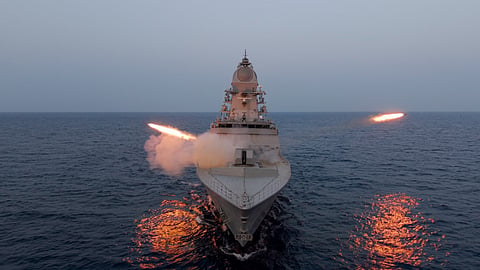

NEW DELHI: The Navy on Saturday commissioned INS Mahendragiri at Visakhapatnam, its sixth new-generation Project 17A stealth frigate, in just 18 months period.
The 6,670-tonne warship was delivered in 31 months, while similar frigates took 63 months earlier, indicating that the country's warship-building assembly lines are striding ahead at a vital pace.
Defence Minister Rajnath Singh, presiding over the ceremony, said the frigate will safeguard India's maritime interests not just near the coast but also in the deep oceans.
Kitted with BrahMos supersonic cruise missiles, medium-range surface-to-air missiles paired with multifunction radars, torpedo tubes and anti-submarine rocket launchers, an electronic warfare suite and a multi-role helicopter, the 28-knot frigate has over 75 per cent indigenous content.
It was designed in-house by the Navy's Warship Design Bureau and built by Mazagon Dock Shipbuilders (MDL).
Mahendragiri is the sixth of the seven 'Nilgiri-class' frigates. The six being Nilgiri, Udaygiri, Himgiri, Taragiri and Dunagiri.
With Vindhyagiri, the seventh frigate in line, the Rs 45,000 crore project will be completed.
Navy’s new chief, Admiral Krishna Swaminathan, said the halving of launch-to-delivery timelines for the class has come alongside a 20 per cent cut in overall construction time, from 95 to 75 months.
Notably, Mahendragiri wrapped up all technical evaluations in a single sea trial, against the usual five to seven.
Sources in the defence and security establishments further said that four more ships are slated for delivery to the Navy over the next two months.
"The target for 2026 is to commission at least 18 vessels, including the last Project 17A frigate, anti-submarine warfare shallow water craft (ASW-SWC), the diving support vessel Nipun and other auxiliary vessels," they said.
The compressed timelines are significant for a Force that has long been plagued by tardy deliveries from defence shipyards.
China, with the world's largest Navy at over 370 warships and counting, adds new hulls at an unprecedented pace, even as its research vessels and submarines foray into the Indian Ocean Region.
Significantly, Rajnath Singh dwelt on the changing character of warfare, stating that even if drones, AI, cyber and hypersonic weapons have transformed conflict, conventional capabilities remain the bedrock of defence.
"Future wars may be fought with Artificial Intelligence, but they will still be won by national resolve, trained soldiers and credible military power," he said, citing Operation Sindoor as proof of the two working in tandem.
"The Navy's escort of 18 merchant vessels carrying cargo worth over Rs 9,000 crore during the West Asia conflict, under Operation Urja Suraksha, showed the Force was a 'First Responder and Preferred Security Partner' in the Indo-Pacific," he added.
The Minister had set the stage a day earlier, highlighting 'Barakhana' in Vizag, that "India stands as the primary guarantor of peace and stability in the Indian Ocean Region," through which over 90 per cent of the country's trade by volume flows.
"The region is our courtyard, and securing the courtyard is our responsibility," he said.
Cautioning that future conflicts could erupt 'without a formal declaration of war,' Singh promised troops the world's best weaponry. However, he also stated that weapons alone do not win wars, and it is the people who wield them that do.
