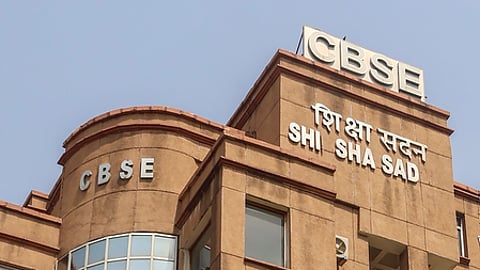

The Central Information Commission (CIC) has directed the Central Board of Secondary Education (CBSE) to disclose "point-wise categorical" information permitted under the Right to Information (RTI) Act regarding expenditure on board examinations and the procurement of answer books for Class 10 and Class 12 exams.
In its order, the CIC set aside the CBSE's earlier refusal to provide the information and instructed the board to issue revised replies.
It said information exempt from disclosure could be redacted or masked under Section 10 of the RTI Act, while any denial under Section 8(1)(d) must be properly justified.
The case stemmed from an RTI application seeking details of answer books used in the 2023-24 and 2024-25 Class 10 and Class 12 board examinations. The applicant had sought information on paper quality, number of pages, size, procurement cost, total expenditure, GST payments, and the tendering process used to procure the answer sheets.
In its response, the CBSE disclosed certain specifications of the answer books, stating that the paper used ranged from 60 GSM to 120 GSM, answer books contained 8, 20, 32, 40 or 48 pages and were available in sizes of 22 x 28 cm and 37.5 x 54.5 cm.
The board also said records regarding the weight of individual answer books were not maintained.
However, information relating to the purchase cost of answer books, the number purchased and total expenditure incurred on procurement was denied under Section 8(1)(e) of the RTI Act.
On queries regarding the tender process, names of participating firms, rates quoted and vendor selection, the CBSE said the matter was related to "confidential" and "sensitive" activities of board examinations and claimed exemption under sections 8(1)(d), 8(1)(e) and 8(1)(g) of the Act.
The board also stated that expenditure data for examination fees was maintained on a financial year basis instead of academic sessions and declined to provide specific expenditure details.
It also informed the applicant that expenditure on practical examinations was booked under a broader expenditure head and could not be segregated separately.
The appellant challenged the response before the CIC, arguing that larger public interest and transparency warranted disclosure of information relating to procurement and expenditure.
Information Commissioner Sudha Rani Relangi observed that the core issue in the appeal was the denial of information related to the "tender process for purchase of answer sheet and other related stationary materials" despite the appellant's contention that larger public interest justified disclosure.
The Commission found that the Central Public Information Officer (CPIO) had denied information under multiple exemption clauses "without giving any proper justification in this regard".
It also noted that the CPIO neither appeared during the hearing nor filed any written statement to justify the denial of information.
"Accordingly, the impugned reply of the CPIO dated 18.03.2025 in the absence of any justification for denial of the information sought, is hereby set aside," the CIC said.
Referring to transparency in public procurement, the Commission observed that "time and again" the Supreme Court and the CIC had emphasised that such exemptions must be construed strictly to ensure accountability in public procurement and contracts by public authorities.
"Now, considering the averments of the Appellant during hearing regarding irregularity on such tenders, the Commission, deems it fit, to direct, CPIO to revisit the contents of the RTI application in question and provide a revised point-wise categorical replies along with relevant permissible information that can be provided as per the provisions of the RTI Act, 2005," the CIC said.
The CIC further said the CPIO ought to have disclosed permissible information while redacting only those portions exempt from disclosure under the RTI Act.
"Information which are exempted from disclosure be redacted/masked under Section 10 of the RTI Act, 2005. In case the information sought is covered under Section 8 (1)(d) of the RTI Act, 2005, the CPIO may justify such denial by giving justification under Section 19 (5) of the RTI Act, 2005," the order said.
Section 8 (1) (d) deals information such as commercial confidence, trade secrets or intellectual property, the disclosure of which would harm the competitive position of a third party, unless the competent authority is satisfied that larger public interest warrants the disclosure of such information.
(With inputs from PTI)
