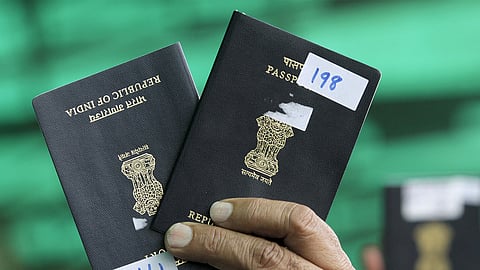

NEW DELHI: The Union government on Thursday sought to defuse the controversy over whether an Indian passport can be treated as proof of citizenship, asserting that the position being cited in recent debates is neither new nor a policy shift.
The clarification came a day after an MEA official said a passport is primarily a travel document and should not be treated as conclusive proof of citizenship. The remarks triggered political criticism and sparked an online debate over whether the government was diluting the evidentiary value of one of the country's most trusted documents.
Government sources said there was no change in the government's stance and rejected suggestions that the clarification issued by the Ministry of External Affairs (MEA) reflected a fresh interpretation of the law.
"It was not decided yesterday that a passport is not proof of citizenship. It was not even decided in the last 12 years," a government source said.
"Nor is this a position that emerged in the last 12 years. A passport has never been considered conclusive proof of citizenship," the source added.
Officials also pointed to the legal framework governing the issuance of passports. "The Passports Act, 1967 clearly provides that passports may be issued to non-citizens under certain circumstances," a source said.
The government also cited judicial precedents to support its position. "Judgments of the Bombay High Court since 2013 have also made it clear that a passport, by itself, is not proof of citizenship," the source said.
Government sources, however, maintained that the interpretation was being misread and reiterated that the legal position has remained unchanged for decades. "A passport is issued after due verification, but it is not, in law, a conclusive determination of citizenship," a source said.
'Which document then is proof of citizenship?'
The MEA's clarification triggered political reactions, with opposition leaders questioning which documents could serve as proof of citizenship.
Trinamool Congress leader Mahua Moitra criticised the statement, saying on X: “It would seem that the only proof of Indian citizenship today is to be both Hindu and a BJP voter. Nothing else will do.”
Rajya Sabha MP Kapil Sibal also raised questions over the issue, posting on X: “Which document then is proof of citizenship? BLO can doubt my citizenship. Deprive me of my vote. Result BJP wins the election. Over to Supreme Court!”
Lyricist Javed Akhtar also criticised the clarification, calling it “absurd” and questioning how passports could be issued without verification of citizenship.
The issue has also featured in discussions on electoral roll revisions. The Supreme Court has observed that Aadhaar is not conclusive proof of citizenship and primarily serves as an identity document.
In 2019, the Press Information Bureau (PIB), in an explainer on the Citizenship Amendment Act (CAA) and the National Register of Citizens (NRC), said citizenship is determined under the Citizenship Act, 1955, and the Citizenship Rules, 2009.
Under Indian law, citizenship can be acquired through five routes: birth, descent, registration, naturalisation and incorporation of territory.
