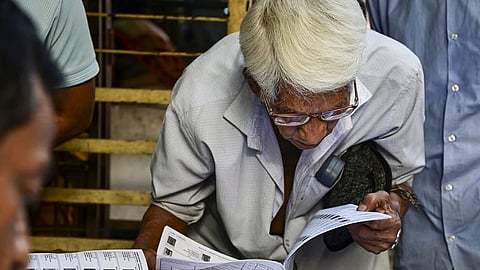

NEW DELHI: The Supreme Court has upheld the power of the Election Commission of India (ECI) to conduct Special Intensive Revision (SIR) of electoral rolls, after noting that the Commission did not violate the Representation of People (RP) Act by ordering SIR of Bihar electoral rolls.
A three-judge bench of the top court, headed by CJI Surya Kant and comprising Justices Joymalya Bagchi and VM Pancholi, on Wednesday delivered its verdict on a batch of petitions challenging the constitutional validity of the SIR exercise of voter lists in various states.
The bench had reserved its judgement on January 29.
It had examined three questions -- whether the EC has the power to conduct an exercise like SIR, whether the inquiry under the SIR is founded on a legitimate purpose, and if the procedure adopted was contrary to or in violation of the provisions of the Representation of the People (RP) Act.
The top court agreed with the EC's grounds for the SIR.
"The ECI has the authority to conduct the SIR exercise and did not transgress any statutory or constitutional provision. The EC did not violate RP Act by ordering SIR of Bihar electoral rolls as such an exercise ensured purity of electoral roll and aided in free and fair elections," the bench ruled.
The apex court also held that the SIR exercise was based on legitimate means to ensure integrity of electoral rolls and had inbuilt safeguards.
The bench added that the EC is doing this for free and fair election.
"The entire process of SIR, including the staged procedures for deletions along with opportunity for claims and objections and the safeguards, makes it valid and non-arbitrary," it said in the judgment.
"The impugned SIR exercise neither stands in direct conflict with the RP Act and the 1960 Rules, nor does it detract from the constitutional imperative of free and fair elections. It is, instead, an exercise traceable to Section 21(3) of the RP Act read with Article 324 of the Constitution, undertaken to advance the very objective which Part XV of the Constitution is designed to protect," the court added.
The bench also stressed that the impugned SIR exercise, as conducted, satisfies the requirements of proportionality. The measures adopted bear a rational nexus to the objective sought to be achieved, are not manifestly excessive, and are accompanied by sufficient procedural safeguards to prevent arbitrary exclusion.
The impugned exercise was founded upon a legitimate and constitutionally grounded purpose, namely, the restoration of the accuracy, completeness, and integrity of the electoral rolls, it observed.
"Having regard to the nature of the problem sought to be addressed, the scale of the exercise undertaken, and the procedural safeguards incorporated during its implementation, the measures adopted by the Commission cannot be said to be disproportionate to the object sought to be achieved," it highlited.
The top court decided whether the Election Commission has the power to conduct SIR in its present form under Article 326 of the Constitution, the Representation of the People Act, 1950, and the related rules.
In its 124-page judgement, the bench observed that inclusion in the electoral roll gives rise to a rebuttable presumption of validity and does not create a blanket bar on the ECI's powers to undertake a SIR exercise.
"The deletions effected pursuant to the Impugned SIR exercise cannot be said to be contrary to the procedure prescribed under Rule 21A of the 1960 Rules. The safeguards of notice and hearing are preserved in substance, and the process adopted by the Commission remains within the bounds of the statutory mandate," it added.
The court also upheld ECI’s documentation framework, saying the classification of documents, including the exclusion of certain categories apart from Aadhaar card — which were later directed to be included vide Order dated 08.09.2025 — was based on "intelligible criteria" linked to maintaining the integrity of the electoral roll.
The batch of petitions -- which were filed in June last year following the ECI's decision to conduct SIR in Bihar and other states -- includes the ones filed by; NGOs -- The Association of Democratic Reforms (ADR),
People's Union for Civil Liberties (PUCL), Political activist Yogendra Yadav, Mahua Moitra (Member of Parliament from TMC- Trina Mool Congress), Manoj Jha (Rashtriya Janta Dal MP), K C Venugopal (Congress MP), Supriya Sule (Nationalist Congress Party, MP), Mujahid Alam, National Federation for Indian Women (NFIW), and others.
The ECI had last year directed to conduct an SIR in Bihar and many other states. Following this, a batch of pleas have been filed before the top court challenging the constitutional validity of the entire exercise.
The petitioners from the top court sought a direction to set aside the ECI’s SIR order of 24, June, 2025.
"Issue a writ, order or direction setting aside Order and Communication dated 24.06.2025 and accompanying guidelines issued by ECI to conduct SIR of the electoral rolls in Bihar as being in violation of Articles 14, 19, 21, 325, 326 of the Constitution of India and provisions of Representation of People (RP) Act, 1950 and Registration of Electors Rules, 1960," said, the plea of ADR, filed in the top court.
The court also impleaded all the political parties in the batch of pleas challenging the EC's drive launched on June 24 for Special Intensive Revision of electoral rolls in Bihar.
On July 28, the Supreme Court in its order refused to stay the EC from publishing draft voters list on August 1, 2025, after SIR exercise in Bihar.
The ECI defended the SIR exercise and submitted to the top court that it was a legitimate and correct process conducted in various states.
