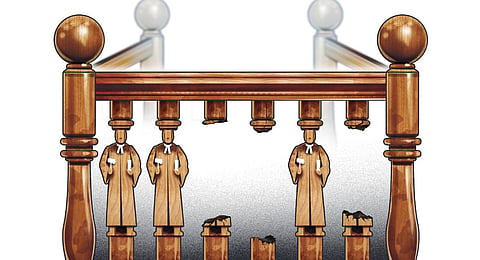

NEW DELHI: More than 7,300 posts in the district judiciary and nearly 300 judges’ across the State High Courts remain vacant. With the total pendency of cases now exceeding 5.8 crore, the justice delivery system is under severe and growing strain and the dispensation of justice is getting worse day by day.
A board outside a courtroom says the judge is on leave, or the post is vacant. Inside, hundreds of files are waiting. Outside, hundreds of litigants are waiting.
Some have been waiting for 10 years, some even for 15 years. Retired HC judges and legal experts familiar with these issues feel there is an urgent need to address them, and the solution is simple and non-negotiable: ensure appointments are time-bound, along with other issues that need to be addressed quickly, including making the Collegium transparent.
Retired Allahabad HC Judge Justice S R Singh, while talking to TNIE, said that this is not a failure of law. This is a failure of appointments of judges.
"The biggest reason is delay. Retirement dates are known years in advance, yet the process to fill the vacancy starts only after the judge retires. A file moves from the HC Collegium to the Law Ministry, then to the Intelligence Bureau, then back to the HC Collegium, then to the SC Collegium, then again to the govt. This journey takes one to two or even nearby to three years. By the time one vacancy is filled, two more have arisen. This should have to be addressed," he said.
Another top legal expert and former Additional Solicitor General (ASG) and Senior Supreme Court lawyer K C Kaushik, said the HC Collegium must recommend names six months before the vacancy arises to the SC Collegium.
The govt must decide within 60 days. "The SC Collegium must decide these within 90 days. If the govt does not respond, then the recommendation should be deemed approved. No vacancy should remain unfilled for more than six months," he added.
Highliting that people have a right to know why a particular lawyer was chosen for the judgeship and why another was rejected, Kaushik said. "Publish the criteria, publish the names considered, publish the reasons for deferment. Transparency will bring merit to the front," he clarified.
Former Patna HC Judge and Senior SC Advocate Justice Anjana Prakash said that if judges' appointments were not been made at the right time, then it will directly affect the dispensation of justice. As many cases of litigants could not be disposed of due to vacancies of these judges across Courts.
"From civil disputes to criminal appeals, to matrimonial cases are stuck in the system for years. The vacancies of judges are a direct blow to the promise of speedy justice. It must be addressed as possible as it can be," she stressed.
At present, nearly 25 percent of sanctioned posts of judges in HCs and District Courts are vacant. In the lower judiciary, more than 2,000 posts are empty. In some HCs, the vacancy is above 25 percent. How can justice be delivered when one-fourth of the chairs are empty?, Justice Prakash questioned.
As per the National Judicial Data Grid (NJDG), over 64 to 65.5 lakh (6.4–6.5 million) cases are pending across all state HCs in India, with approximately 300 to 350 judicial vacancies out of over 1,122 sanctioned posts.
As of November 2026, the total number of pending cases in the SC stands at approximately 93,000 to 95,000 cases based on recent NJDG and registry sources.
Roughly 18,375 registered civil cases (plus unregistered/defective matters) were pending in the SC. The criminal cases roughly 73,967 registered criminal cases (plus unregistered/defective matters).
Former Judge of Allahabad HC Govind Mathur said that major reason for delays in the disposal of cases is the lack of cooperation from the govt and its agencies.
"The govt and its instrumentalities constitute the largest litigant in the country, yet the timely disposal of litigation appears to be among their least priorities. Govt departments and agencies are frequently represented by inefficient and inadequately prepared advocates who are often unable to assist the courts effectively or provide appropriate legal advice to their respective departments. Such deficiencies contribute significantly to unnecessary adjournments and delays in the judicial process," he told TNIE from Germany.
