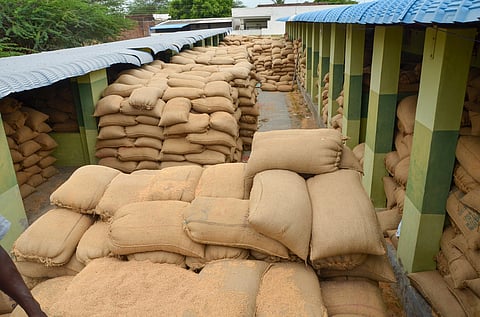

RAIPUR: The procurement of paddy at Minimum Support Price (MSP) in Chhattisgarh, which began on Sunday, underwent a significant technology-driven overhaul.
For the Kharif marketing year 2026–27, the state government has established a comprehensive digital surveillance framework that tracks every stage—from initial farmer registration, weighing, payment, and storage, up to the final supply of milled rice.
Utilising tools like biometric authentication, AgriStack farmer IDs, digital crop surveys, electronic weighing scales, and QR codes, the initiative ensures that only genuine farmers sell their produce while minimising any scope for manipulation.
To sell paddy this season, registration on the AgriStack portal is compulsory.
Farmers must obtain an AgriStack ID (Farmer ID) and link their respective land parcel's (khasra) Farm ID to their unique identity.
Procurement eligibility is strictly determined based on the crops recorded and acreage verified through digital crop surveys. Furthermore, AI-based image validation and QR code verification are being deployed to pre-empt fraudulent entries.
Beginning in Kharif 2026–27, 100% scanning of QR codes on rice bags will enable seamless tracking of grain movement from mills to the Food Corporation of India (FCI), the Civil Supplies Corporation, and fair-price shops. This ensures rigorous stock monitoring, bag identification, and strict control over potential diversion.
To streamline financial settlements, paddy payments will be transferred directly into farmers' bank accounts via digital channels, with computerised payment receipts generated right at the procurement centres.
Additionally, all inbound and outbound logistics data at paddy collection centres will be logged into a web-and-computerised network management system.
Purchases will run at Rs 3,100 per quintal (up to 21 quintals per acre) across 3,100 procurement centres, including 360 newly opened centres designed to cut travel time and congestion. Over 27.5 lakh paddy farmers are registered.
