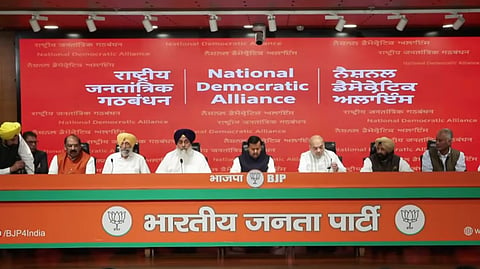

CHANDIGARH: The broad ground sentiment, backed by survey findings suggesting that the Bharatiya Janata Party (BJP) and the Shiromani Akali Dal (SAD) as "nau-maas da rishta" (the bond between the nail and the flesh), could regain their footing in Punjab if they joined hands which remained an important consideration as both parties revived a political partnership that lasted nearly 24 years before falling apart over the Centre's farm laws in 2020 ending a six-year break, ahead of the 2027 Punjab assembly elections.
The two former allies have been moving towards a reunion for the past few months, with the announcement expected in November. Both parties had parted ways in September 2020 at the height of the farmers' agitation against three farmers' laws now repealed, when the Akali Dal broke away from the National Democratic Alliance and senior leader Harsimrat Kaur Badal resigned from the Union cabinet in protest. They fought together in 1997, 2002, 2007, 2012 and 2017, winning three of those five elections and governing Punjab for 15 years.
The first signs of a thaw between estranged allies BJP and SAD emerged on April 27, 2023, when then BJP president JP Nadda attended the last rites of SAD patriarch Parkash Singh Badal in Lambi, near Bathinda, Punjab. It was the first time since the Akali Dal walked out of the NDA over the farm laws in September 2020 that leaders of the two parties had come together, albeit on a sombre occasion.
After that, there were no visible signs of a reunion thereafter, the BJP continued to maintain that it was the Akali Dal that had left the NDA and that the BJP never betrayed its allies. But the leaders of the two parties, however, remained in touch privately.
A second significant indication came when Prime Minister Narendra Modi wanted to mend ties with estranged allies came during a recent meeting of NDA partners, when he fondly recalled NDA stalwarts Parkash Singh Badal of the Akali Dal, Bal Thackeray of the Shiv Sena and BJP leader Atal Bihari Vajpayee. The gesture was seen as a subtle outreach to former allies, including Sukhbir Badal and Uddhav Thackeray, signalling that the door was open for their return to the NDA.
Then, in August this year, the meeting between PM Modi and Sukhbir gave a clear signal of a possible reunion. Thereafter, the BJP and Akali Dal leadership got down to the nitty-gritty of seat-sharing arrangements and other details of the alliance. Then Modi’s trusted aide and senior BJP leader CR Patil came into the picture to oversee election surveys in the state, underlining the Prime Minister’s personal involvement.
Patil was given several ground surveys which indicated that while the BJP and the Akalis were struggling individually, together they could emerge as a formidable force.
These findings were shared with Modi and Union Home Minister Amit Shah. Though Shah was initially opposed to the alliance, he gradually came around as the party weighed the larger political and national considerations, said sources.
Then Union Home Minister Shah subsequently began focusing his Punjab visits on meetings with families who had lost their loved ones to drugs. He personally met the families of Parvinder Singh Jhota and others, promising stringent action against drug networks across the state. He had recently indicated the possibility of a reunion, saying Punjab would have an NDA government.
Akali Dal sources said the prevailing sentiment in Punjab was that "ten wasted years of governance needed to be reversed with a government that can deliver". "The sentiment is that the Akalis, with BJP support, can bring Punjab back from the verge of economic and social mess. Ten years ago, Punjab was a revenue-surplus state, but no longer," said a senior SAD leader.
The only assembly election they did not contest together during the past three decades was in 2022, when both parties fought separately and were reduced to margins. The SAD, contesting in alliance with the Bahujan Samaj Party (BSP), won just three seats, with its vote share falling from 25.24 percent in 2017 to 18.38 percent.
The BJP, which tied up with Amarinder Singh's Punjab Lok Congress and Sukhdev Singh Dhindsa-led SAD (Sanyukt), won two seats. The AAP swept Punjab, winning 92 seats.
Efforts to revive the alliance ahead of the 2024 Lok Sabha polls failed amid renewed farmers' protests. In 2019, the SAD and the BJP won two Lok Sabha seats each, polling a combined 37.08 percent of the votes. Five years later, the BJP's vote share rose from 9.63 percent to 18.56 percent as it contested all 13 seats, while the SAD's fell from 27.45 percent to 13.42 percent.
The BJP drew a blank, while the SAD retained Bathinda. Their combined vote share of nearly 32 percent was, however, higher than that of either the Congress or the AAP. This strengthened the proponents of reviving the alliance.
Leaders from both sides have described the reunion as an effort to restore a partnership built around Punjab's peace and stability, rather than merely an alliance for power.
The alliance which took place in 1996 delivered the results a year later, in the 1997 assembly election, it won 93 seats, with the SAD getting 75 and the BJP 18. Thus, the Congress was reduced to 14 seats, and Parkash Singh Badal became chief minister again.
In the 1998 Lok Sabha election, the two parties won all 11 seats they contested, with the SAD winning eight and the BJP three. The alliance lost the 2002 assembly election to Congress but returned to power in 2007 by winning 67 seats. It won again in 2012, marking the first time a government in Punjab was re-elected to office after the state's 1966 reorganisation.
