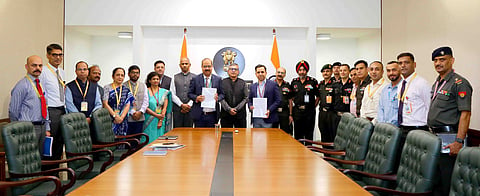

NEW DELHI: With drones fast emerging as the weapon of choice on modern battlefields, the defence ministry on Wednesday inked a Rs. 770 crore contract with state-run Bharat Electronics Limited (BEL) for improved low-level lightweight radars (LLLR-I) that can detect and track everything from fighter jets to mini and micro drones.
The contract is meant to plug critical gaps in the Army's air defence (AD) network at low altitudes. "The LLLR(I) system has the capability of detecting and tracking fighter-size targets and mini/micro drones. It has the additional capability of prioritising aerial targets. This will enable the Army to successfully counter the threat of Unmanned Aerial Systems (UAS)," the MoD said.
The LLLR-I is an upgraded version of the Aslesha radar, designed by DRDO's Electronics and Radar Development Establishment (LRDE) and produced by BEL. While the Aslesha is an S-band 3D radar with a semi-active array antenna, the new one uses four fixed phased-array panels based on gallium nitride (GaN) active electronically scanned array (AESA) technology to provide 360-degree coverage, with no moving parts.
Digital beam-forming and 3D processing allow it to pick out small drones with a low radar cross-section (RCS). It can track targets while scanning and feed data to weapon systems through wired and wireless links. Being man-portable, it can be easily deployed in the plains, deserts as well as high-altitude areas.
Low-level radars essentially act as gap-fillers in the larger AD grid, covering the low altitudes where long-range radars are hampered by terrain and the earth's curvature. This is precisely the airspace exploited by drones. The Army has wanted radars that can detect targets with an RCS as small as 0.001 sq m, which is that of a micro drone.
The need was driven home during Operation Sindoor, when Pakistan launched waves of drones, including Turkish and Chinese-origin ones, towards military and civilian locations along the western front during the four-day hostilities. A large number of them were shot down by Army AD units.
The MoD, on its part, said the procurement is "a significant step towards indigenisation of air defence platforms", which would also boost the domestic defence manufacturing ecosystem, including micro, small and medium enterprises (MSMEs).
