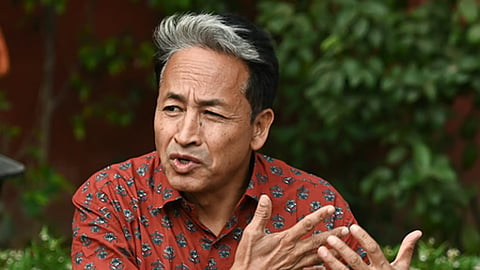

Sonam Wangchuk, the renowned educationist, innovator and environmentalist from Ladakh, speaks to TNIE about the emerging political force CJP, Ladakh’s demand for greater autonomy and the urgent need to protect the fragile Himalayas.
He says “democracy must be restored in the Union Territory” before any major decisions are made, while arguing that the CJP should remain a neutral pressure group that holds all political parties accountable rather than becoming a political party itself.
Ahead of the September 9 meeting between the Leh Apex Body and the Ministry of Home Affairs, Wangchuk also discusses Ladakh’s political aspirations, constitutional safeguards and the growing environmental challenges facing the Himalayan region. Excerpts:
Do you consider CJP primarily a student/youth movement, a civil-society movement, or is it evolving into a political force?
Currently, I wouldn’t categorise it as a political party, but rather as a political force. It functions like a pressure group, aiming to keep all parties accountable without aligning with any specific side. There is a need for such an entity to remain apolitical while promoting accountability among all political parties.
It is possible to be a pressure group without taking sides. As I see it, this is its role, and I hope it continues in this manner. I’ve mentioned multiple times that if an individual chooses to join a party or start one, that is perfectly fine—after all, we need leaders. However, the platform they have created so far is commendably neutral and politically pure, which I believe is a good strategy.
Where do you draw the line between supporting a youth movement and becoming politically affiliated with CJP?
I’m not referring to party politics in the context of electoral politics, but if we aim to bring accountability to politics in India, then the possibility exists. However, I want to avoid getting involved in any political party dynamics.
If CJP were to offer you a formal leadership position in the future, what would your response be?
I would prefer to keep the youth movement focused on its mission without my direct involvement in leadership. The young leaders are doing well and there is no need for me to occupy a formal position. Whether it’s CJP or any other meaningful youth initiative, I’m willing to advise, mentor and take a stand if there is a serious need for it. However, I believe it’s neither desirable nor practical for me to assume a leadership position for every cause I support.
What would meaningful autonomy for Ladakh look like? What about the September 9 meeting between the Leh Apex Body and the MHA?
Ladakh has been calling for the restoration of democracy, which is enjoyed across the nation and safeguards its unique culture and fragile environment. It is enshrined in the Sixth Schedule of the Constitution. But somehow the government has been unable to consider the Sixth Schedule despite its pledges and promises in election manifestos. So, we are exploring other possibilities.
The latest understanding we have reached is a special provision for Ladakh under Article 371, under which democracy would be restored through a unique, tailor-made, sui generis model. There would be an assembly of elected representatives under which the entire bureaucracy would function.
Unlike now, when we are completely ruled by bureaucracy with no representation whatsoever, an assembly of representatives would make all decisions, with the bureaucracy under it. That has been the understanding so far. Protection of the environment, culture and land under Article 371 is also part of what we have agreed upon so far. We hope that they carry it out in both letter and spirit in the coming meetings.
Has your position on the Sixth Schedule changed after your detention and recent negotiations with the Centre?
Yes, our original position was in favour of the Sixth Schedule. However, we have now agreed to establish a Union Territory-level assembly. This is acceptable to the people as long as it is accompanied by the protections provided under Article 371 of the Constitution. In recent weeks, the government has proposed creating a district-level council, but without the Sixth Schedule provisions, which is confusing for the people.
This creates a situation where we have an assembly in place, along with a district council that does not fall under the Sixth Schedule. Currently, our agreed position is to implement the assembly at the state level with the safeguards of Article 371. After that, we can consider evolving governance to the district and village levels through panchayats. But it shouldn’t be the other way around—establishing district councils first and then the assembly.
How would you respond to those who argue that Ladakh’s strategic location makes greater autonomy unfeasible from a national-security perspective?
This argument is laughable. If we consider Arunachal Pradesh, it was granted statehood on similar grounds. The reasons provided for elevating Arunachal from a UT to a state included its strategic significance, which necessitated more democratic representation. This happened even though it didn’t fully justify the move. At the same time, Mizoram was also being awarded statehood. The rationale of border security was applied then, so how can the same reasoning be used to deny autonomy to Ladakh? A group of vested interests is promoting the narrative that Ladakh should be denied its rights because of its strategic location, aiming to maintain control over the land without allowing the people proper representation.
You have stated that a larger agitation could resume if negotiations do not yield concrete results. What is your deadline?
Yes, we believe that the issues surrounding this agitation, which have persisted for five years, must be resolved first. If democracy is not restored, any significant decisions regarding district management, land policies or other major policies made without a democratic framework will be problematic. Our non-negotiable stance is that democracy must be restored before any major decisions are made. We can’t allow significant decisions like land sales to be taken before the people have a say. Therefore, we hope that by September 9, the government will agree to prioritise the restoration of democracy at the state or UT level. Following that, we can work with representatives of the people on other policies.
The recent floods in Nepal have again exposed the vulnerability of Himalayan communities. What does the disaster tell us?
Much of the current situation stems from global activities that contribute to climate change. This will not change until we alter our behaviour. Even if we do change, it will take time for the planet to heal. This serves as a wake-up call for the entire world.
