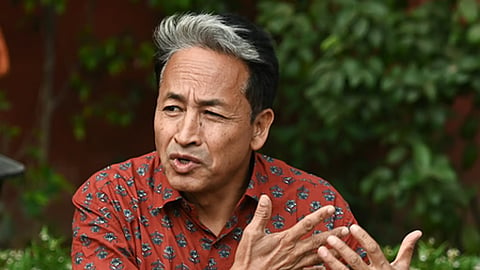

Climate activist Sonam Wangchuk on Thursday accused the Centre of betraying Ladakh after the proposed October 22 meeting between government representatives and local groups was called off, despite both sides exchanging draft proposals earlier this month.
The leader from Ladakh, while addressing the media, asserted that nothing short of a Union Territory (UT) with a legislature and constitutional safeguards would be acceptable to the people of the region.
Wangchuk said representatives of the Leh Apex Body (LAB) and the Kargil Democratic Alliance (KDA) had prepared for the next round of talks following their October 15 meeting in Leh. The two sides had exchanged proposals, compared them point by point and expected to discuss the remaining differences at the scheduled meeting.
“I had already booked my tickets. We made our plans accordingly, but now they are saying the meeting is not happening,” he said, describing the cancellation as another breach of trust.
Wangchuk said earlier discussions between the two regional bodies and the Union Ministry of Home Affairs (MHA) sub-committee had raised hopes of a democratic framework for Ladakh, with constitutional safeguards, greater representation and protection of the region’s distinct identity.
According to him, the Centre had proposed safeguards on the lines of Articles 371A and 371G and agreed in principle to a governance structure covering the entire region, rather than restricting powers to district councils. “After the government cited resource constraints as a hurdle to statehood, the representatives proposed an UT status with an elected legislature and constitutional protections,” he said.
Defending the demand, Wangchuk said Ladakh’s strategic location should not be used to deny its residents democratic rights. Citing Arunachal Pradesh, which became a state in 1987 despite its sensitive border location, he argued that an elected legislature was essential to ensure local participation in governance.
“China is claiming Ladakh as its territory. We condemn that. But do not crush Ladakh under your feet,” he said, warning that the Centre’s approach risked weakening a strategically important border region. “Do not weaken the borders because of your stubbornness,” he added.
Wangchuk alleged that Ladakh was being governed through unilateral administrative decisions, with the powers of district councils curtailed. He likened the Lieutenant Governor’s authority to that of a British-era viceroy and called it a blot on Indian democracy.
He also flagged concerns over land, natural resources and cultural identity, pointing out that nearly 90 percent of Ladakh’s population belongs to tribal communities. He warned that local interests could be sidelined in decisions involving corporate interests and cited protests by women against the expansion of liquor sales, saying many residents wanted the region to remain dry.
While acknowledging improvements in roads, airport infrastructure and the establishment of a High Court bench, Wangchuk said development could not replace political rights. “Whatever good has happened, we salute it. But nobody wants a cage, even if it is made of gold,” he said.
Referring to the September 24, 2025 violence in Leh, he said people had been sitting on a hunger strike when the protest turned deadly.
Wangchuk also linked the controversy over the Special Intensive Revision of electoral rolls to wider questions of democratic representation, arguing that electoral reforms must address regions such as Ladakh, whose residents lack an elected legislative assembly. He maintained that elections alone were insufficient if commitments made to the people remained unfulfilled.
