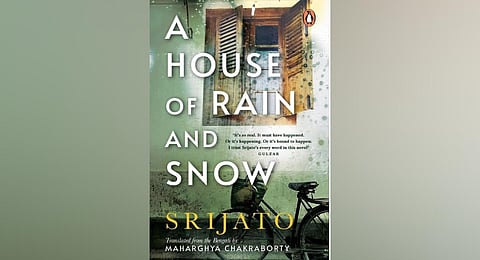

It’s so real. It must have happened. Or it’s happening. Or it’s bound to happen, I trust Srijato’s every word in this novel.” If Gulzar’s words on the cover of the English translation of Srijato’s A House of Rain and Snow aren’t inviting enough, the opening lines of the novel certainly will be. The author is a poet at heart and is telling the story like he is singing a rhyme meant to draw the reader into the world of the protagonist, Pushkar, with each word.
Originally written in Bengali, the novel was gracefully translated by Maharghya Chakraborty, and it is to both their credit that the words take shape in our minds so effortlessly. Srijato picks the reader from the opening sentence and plunges them into Pushkar’s surroundings—from his room, house and neighbourhood to his family and friends. His world is slow and emotional. It is contemplative and complex, but Srijato tells you all about it simply; with a characteristic poeticism.

The narrative is gentle. This is, however, not to say that the book is devoid of intensity. In sharp instances, the author pulls the reader by the collar and throws one into a vortex of emotions. The Calcutta setting maybe unfamiliar for many, but the way the city’s character has been written makes it relatable. There is music, art, literature and the quintessential jhola that accompanies the Bengali intellectual. There is also poverty, despair, loneliness, longing, conversations over past and future, faith, and most of all, love.
The story is in many ways an ode to love. It must be added that there are times when the words wander closely to ‘passion’. Pushkar is a writer, more precisely a poet, who is shy or perhaps, too judgmental of his own work. His friends accompany him through life; at times, may be to his own annoyance. But they are all coming together around him, and he has little idea. Pushkar is in love a girl from his school, Saheli. It’s that familiar sweet love that evokes a sense of belonging. And Srijato brings the romance to life with love letters.
The book is a literary dance, seamlessly transitioning between some really long sentences and some as concise as four words. And, using those, the writer builds up Pushkar’s world.
The book is a leisurely read, and sweetly yet strangely conspires to draw the reader into complexities of affection, a sentiment admired and longed for by most, and even detested by some. The last few chapters, in fact, seep the reader into this inescapable feeling. But, who does Pushkar share it with? A Milkwood tree.
What also must be appreciated is how Srijato writes the feeling of getting published for the first time; the emotional whirlwind and intent and objective of anything artistic. It is these additional layered details that elevate the narrative, making it a sweet world of experiences.