
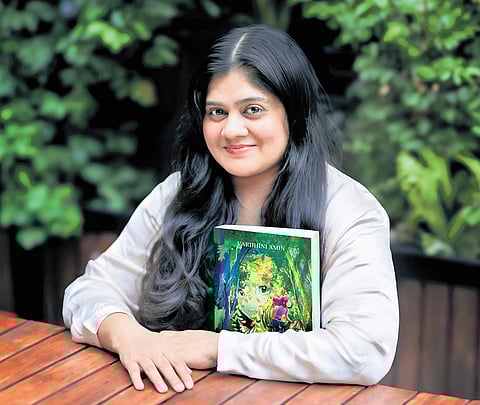
The fantasy is based on real theories, says author of 'The Forestborns'
Most readers will be aware of Darwin’s theory of evolution but may be less familiar with his work “The power of movement in plants”. Darwin has scientifically proved that plants feel, communicate and are sensitive to light and touch. Trees protect themselves and alert other trees in a grove or forest when they are under attack from animals by communicating the danger. Based around this theory is the young adult fantasy novel, The Forestborns, which brings about climate and environmental awareness.
The book is about twins Siah and Avni and how they save the forest from poachers. Interestingly, Siah is a sandalwood tree while Avni is an 11-year-old girl. How did Siah turn into a sandalwood tree is the fantasy portion of the story.
The author makes us question the fundamental premise of all religions—if all life has soul as believed. Then, why is a plant soul or an animal soul less important or less precious than a human soul? Excerpts from the interview:
This is your debut novel. Tell us a little bit about the premise.
I’m a writer and portrait photographer who’s a bit obsessed with plants. I love gardening, and a lot of my story ideas come while I’m walking barefoot on the grass, talking to my plants, or hugging trees. Nature deeply inspires my writing, especially when it comes to weaving imagination into the beauty of the natural world. The Forestborns is a mix of fantasy and nature—themes that are close to my heart.
What made you choose such a plot for your debut novel?
My love for plants and trees inspired the idea of a hidden realm where their souls are alive and free, inviting readers to explore a world we often overlook and take for granted. By combining the idea of tree souls with real-world issues, I found a way to tell a story that’s both magical and meaningful.
Were you aware of Darwin’s scientifically proven “The power of movement in plants”, and how plants feel, communicate and sense danger? Your fantasy novel seems to take the essence of it and apply it to the narrative.
Yes, Darwin’s theory left a lasting impression on me. Also, recent studies that prove plants can sense light, communicate through underground fungal networks, and even form memories that help them adapt to environmental changes contributed to the inspiration for my story. All the fantasy elements in this book are loosely based on real theories and studies.
You have a very visual style of writing. While reading your book, one can see the owl and the trees. Tell us your approach towards writing a fantasy novel.
It comes from my love of reading other authors like Enid Blyton, Frances Hodgson Burnett, Leigh Bardugo, Madeline Miller, and Chitra Banerjee Divakaruni, who have a similar visual style of immersive writing and world-building.
Why particularly sandal wood trees? And why are the protagonists girls?
Sandalwood trees are often the target of illegal logging in India, so they became a natural symbol for the threat that the forest faces in the story. As for the protagonists being young girls, it was a conscious choice to show that traits like strength, bravery, leadership, determination, confidence, stoicism, sacrifice, independence and protectiveness aren’t limited by age or gender.
What is your hope/message that your readers will get from this novel?
I believe that when we genuinely empathise with something, we’re more inclined to care for it. My aim is to highlight critical issues like climate change, deforestation and forest fires from a fresh angle by weaving them into an engaging story. I truly hope this will encourage readers to look at plant life in a new light and feel inspired to take action and make a positive difference.