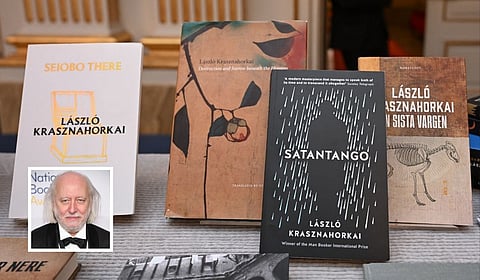

Laszlo Krasznahorkai, a novelist known for lengthy sentences—some of which run into pages—and whom a fellow writer termed "master of the apocalypse", was awarded the Nobel Prize for literature on Thursday.
The 71-year-old Hungarian master, who has written five major novels, first came into the limelight when he debuted with Satantango in 1985. The Nobel Committee would go on to term it "a literary sensation” of its time.
The book was adapted nine years later by Hungarian film-maker Bela Tarr into a 415-minute-long film acclaimed by many.
Tarr, a dear friend, later filmed Krasznahorkai's next masterpiece The Melancholy of Resistance as Werckmeister harmóniák (2000).
The duo also collaborated on Kárhozat (Damnation), released in 1988, and The Turin Horse, released in 2011. Both films saw Krasznahorkai share the writing honours.
Other famous books by the writer, renowned for a "powerful, musically inspired epic style", include War and War (1999) and Seiobo There Below (2008).
Herscht 07769 (released in Hungarian in 2021) happens to be Krasznahorkai's most recent book to have been translated into English and came out in 2024.
The year also saw him publish the satirical Zsömle Odavan, his latest novel.
Krasznahorkai described his writing style as "reality examined to the point of madness".
In a 2014 interview with the New York Times, he spoke of how he had worked to become "absolutely original". "I wanted to be free to stray far from my literary ancestors, and not make some new version of Kafka or Dostoyevsky or Faulkner," he told the newspaper.
Born in Communist Hungary in 1954 into a middle-class Jewish family, Krasznahorkai previously won the Man Booker International Prize in 2015.
"I'm very happy, I'm calm and very nervous altogether," he told Swedish broadcaster Sveriges Radio upon hearing of the award.
He is the second Hungarian novelist, after the late Imre Kertesz (2002), to be awarded the supreme prize in literature.
