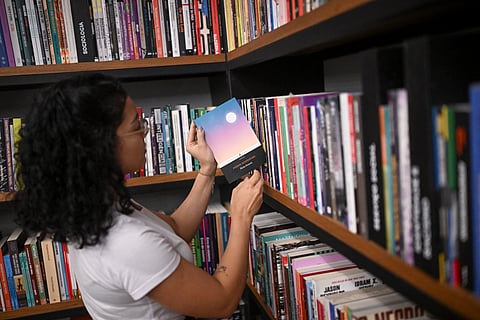

RIO DE JANEIRO: Marcelo Nogueira is not well-versed in the classics but the 27-year-old Brazilian book influencer was seduced by Fyodor Dostoevsky's "White Nights," a 19th-century tale of love and loneliness at the center of an unlikely TikTok craze.
Dostoevsky's story of a dreamer who, while strolling through the streets of Saint Petersburg, meets a young woman with whom he falls madly in love has become a bestseller in Brazil, nearly 180 years after its release.
Editora 34 publishing house told AFP that its sales of the novella, one of Dostoevsky's earliest works, had jumped 463 percent year-on-year.
In the United Kingdom and Spain, it is also flying off the shelves.
Nogueira, who has 13,000 followers on TikTok, explained that Gen Z readers found an echo in "the figure of the solitary dreamer, which is how many young people feel today."
Dostoevsky follows the narrator over four nights and a morning during which he ceases living in his imagination and embraces reality for the first time.
His peregrinations are the prelude to a love story as passionate as it is fleeting.
"My God! A whole minute of bliss! Is that really so little for the whole of a man's life?" the narrator exclaims in one of the lines most quoted on social media, reflecting on the enduring value of brief bursts of joy.
Bowled over
Tens of thousands of comments on BookTok, a popular book community on TikTok, attest to the popularity of one of Russia's greatest novelists with the social media generation.
It "bowls you over: it's real life written in a poetic way," user @thayslaaaa commented.
Paloma Lima, a 29-year-old influencer and fan of Russian literature, told AFP that young TikTok users came to her YouTube channel after reading "White Nights."
"It makes sense" because it's a "short and intense" book and falls into one of the most popular tropes on TikTok, she said, citing popular narratives such as "friends becoming lovers."
In Russia, the phenomenon is a source of both surprise and pride.
Speaking at the Moscow Book Fair, Ekaterina Kvitko, a 28-year-old author, said young Russian readers were far less enthused.
Perhaps it's because it's a "story about a protagonist who is alone, searching for some kind of love, some crutch to lean on. Maybe teenagers in the West are living in that state right now," she mused.
Criticism or advertising?
"White Nights" has emerged as a gateway book for Dostoevsky's work, with some young readers progressing onto more challenging novels, such as "Crime and Punishment."
It's an "unexpected" phenomenon, says Danilo Hora of Editora 34, reporting a 53 percent increase in sales of Dostoevsky's iconic tale of murder and guilt during the first seven months of the year.
In an era when short TikTok and YouTube videos are being blamed for eroding attention spans and fueling a reading crisis, social media, it transpires, is creating new audiences for the classics.
"Being a reader is a very beautiful idea; it can even be marketed. There's an associated aesthetic that's spreading" on TikTok, Nogueira said.
Aesthetics are also driving demand for the physical book over the digital version.
"It attracts more attention to have a wonderful cover than a Kindle," said Nogueira.
For his video discussing the book he used an edition with a colorful pop-art cover of a couple kissing, which is sold out in several bookstores in Rio de Janeiro.
Cecilia Rosas, a Brazilian researcher and translator of Russian literature, hailed the interest in the classics on social media.
She stressed, however, the importance of distinguishing between literary criticism and what often passes for such on social media but which, in her view, amounts to "advertising."
