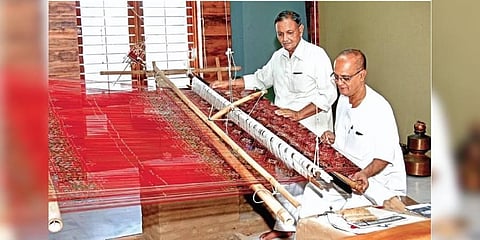

When we talk of a living family legacy, the saga of the Salvis is a story that needs to be told. A family that has, for the past 900 years and 35 generations, preserved the craft tradition of patola weaving. But to fully appreciate the artistry behind this ‘queen of silks’, one must first go back into history a bit. The aforementioned 900 years ago, to be exact.
In 12th century AD, King Kumarapala of the Chalukya dynasty of Gujarat invited a group of weavers from Jalna in Maharashtra who crafted a special kind of silk used for prayers. These were the Salvis or ‘weavers of silk’ and this special weave was patola. Out of the 700 craftsmen that moved to Patan, Gujarat, only one such family continues the tradition of weaving patola the authentic way today. They were recently seen showcasing their spectacular collection at an exhibition in Chennai organised by the Crafts Council of India.
Tracing the journey of this elaborate textile, master craftsman Rahul Vinayak Salvi, explains that for much of their centuries-old history, these silks were more famous outside India than within. “Our ancestors exported patola to Malaysia, Thailand, Indonesia and Japan, where these were a rage. The fabric was considered to be holy and was used only by the royals,” he says.
The weave was so perfect that it was considered a divine creation containing mystical and miraculous powers, a magic cloth which protected the wearer from evil, ill-health and even in battle. It was believed that by wearing a patola, one feels the presence of god. The demand was so huge that it spawned Patan-inspired traditions across these regions.

Patola primarily uses the ikat technique—an intricate pattern of weaves wherein the threads are first coloured and then woven.
In the case of Patan’s patola, the designs are on the thread itself. A complex method of tying and dyeing is used directly on the thread, a process popularly known as double ikat.
Patola sarees are woven using dyed threads, both in tano or warp and vano or weft to create the design. The strings are dyed according to a pattern, and the dye marks align when woven, forming the designs on the cloth.
Mathematical precision is used to ensure that the design meshes together. The resultant patola silk has no reverse side, as both sides have equal intensities of colour and design, making it a vibrant feast for the eyes. From start to finish, designing and making one saree takes six to eight months. Owing to its dextrous process, painstaking complexity, labour and time-intensiveness, the cost of a sari ranges anything between Rs 1.5-5 lakh.
Salvi says his family firm, Patan Patola Heritage, is the only one practising authentic patola weaving. “A lot of people make patola, but they use chemical dyes and the quality deteriorates,” he says.
The Salvis are recognised by UNESCO for their use of natural dyes. The striking colours don’t fade and remain intact for centuries as these patola custodians have ensured that all colours are sourced organically.
They only use turmeric, marigold flowers, onion skin, pomegranate bark, lac and indigo along with different mordants.
Even the patterns have been passed down for centuries, with each having an individual significance. “Traditional motifs are called bhat and include narikunjar (woman and elephant), paan (peepul leaf), laheriya (diagonal lines), choktha (square), rattanchowk (geometric) and navratna (nine gems) among others. Narikunjar is the most popular choice for anyone buying their first patola,” Salvi says.
The patola is woven on a primitive hand-operated harness loom made out of rosewood, teakwood and bamboo strips. This traditional slanting loom is the only loom in the world that can be inclined and declined. This peculiarity adds to the unparalleled texture of the fabric, he adds.
At their home in Patan, which also houses their workshop and a Patola museum, Salvi says his family members themselves sit on the looms and weave. No workers are hired from outside. That’s because they do not want to pass on the technique to anyone else, as they are against commercialising it.
“If you do this art form for money and go in for mass production, the quality suffers. This has been our tradition for the past nine centuries, and 35 generations have worked against all odds to keep it alive. Our sole aim is to preserve this art perfected by our ancestors and pass it on to our progeny,” he explains.
The fruits of their labour have earned them multiple national awards and accolades. Something that spurs them to strive even higher.