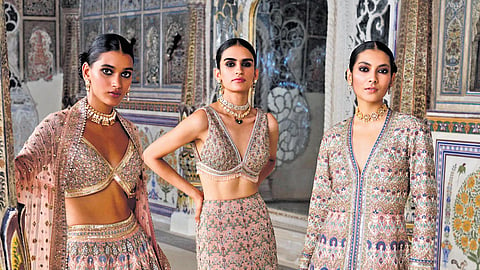

Italian fashion designer Orsola de Castro once said, “It isn’t enough just looking for quality in the products we buy, we must ensure there’s quality in the lives of people who make them.” That is exactly what Mumbai-based couturier Anita Dongre’s latest bridal collection Raahi is doing—celebrating the master artisans of our country. Centred around the craft forms of Bandhani, Ajrakh, Pichhwai, Badla, and Gota, the collection seeks to marry heirloom traditional crafts with contemporary and classic silhouettes. “By incorporating these crafts, we honour and preserve traditional artistry while creating timeless and elegant designs,” says Dongre.
In the process, like all of her collections, Raahi too strives to empower the Indian bride—an unapologetic, assertive, independent woman who questions and doesn’t just follow. Featuring outfits with pockets, designed to blend fashion with comfort and functionality, Raahi is an ode to the modern bride who promises to be her own confidant,” says Dongre, adding, “The modern bride is self-assured. She values her identity, and celebrates her relationship with herself. She seamlessly blends traditional elements with her modern sensibilities, creating an aesthetic that honours heritage while embracing trends.”
Honouring Craftsmanship
The hand-painted art of Pichhwai, Badla and Gota Patti from Rajasthan, the vibrant Bandhani from Gujarat and the age-old weaves from Varanasi are celebrated in a language that is global in its appeal. Dongre says, “Gota holds a special place in my heart as it’s from my home state. It was the first craft we worked with when we started our bridal line. Its exquisite embroidery enhances the grandeur and intricate detailing of our bridal wear, reflecting the opulence of Rajasthan’s craftsmanship.

Our journey with Pichhwai was also serendipitous. I met the artisan painting frescoes in the City Palace of Jaipur on a shoot. Now, he’s trained and has set up a team of artisans that paints lehengas, bags, and even panels in our store interiors,” the designer says, adding, “Bandhani adds a splash of colour and texture to our lehengas and saris, bringing a playful yet elegant touch.”
Dongre also collaborates once again with Reema Nanavaty of SEWA (Self Employed Women’s Association)—a traditionally-skilled women artisans group in rural Gujarat. SEWA currently works with around 2.9 million women across India, spanning multiple craft forms. This is the eighth year together for both these pioneering women. Dongre says, “Our previous collaborations have been incredibly rewarding.” Raahi, however, goes a step further by experimenting with these crafts to create contemporary designs. It integrates the traditional crafts into high fashion.
Old is New
Dongre launched her first Picchwai collection in 2019. It comprised of 15 hand-painted limited-edition pieces. The latest range, however, differs in its approach and scope. The idea with Raahi was to wearable pieces of art. Dongre says, “While the 2019 collection focused on Pichhwai’s storytelling, Raahi integrates multiple crafts, including Bandhani and Gota to offer a more diverse tapestry of Indian heritage.”
Nurturing Nature
Those who have followed Dongre’s journey as a designer, would know that nature is her biggest inspiration. Her designs are replete with bird motifs and forest imagery. She says, “Nature symbolises freedom, beauty and the intricate patterns of life. By incorporating these elements into my designs, I hope to create a sense of peace and joy. It is a reminder of our responsibility towards nature. It’s also about celebrating the natural world and fostering a deeper appreciation for its wonders through fashion.”
Sustainability and Bridal Couture
Fashion today is a lot about sustainability. This pivotal shift not only enhances the quality of the garments, but also underscores a dedication to responsible resourcing. Raahi encourages brides to wear designs that can be restyled and worn for different occasions. Dongre says, “Sustainability is at the core of our design philosophy, even when it comes to bridal couture. We believe that the grandeur and opulence of bridal wear can coexist with environmental responsibility.
Which is why, we emphasise the use of eco-friendly fabrics—they are luxurious and have a lower environmental footprint. We also focus on creating outfits that are versatile and can be worn beyond the wedding day. Additionally, our packaging is made from recycled materials, and we continuously strive to reduce waste throughout our production process.”