
Colouring outside the lines
When it comes to garments, it doesn’t get more traditional than a sari. The long, flowing piece of fabric is as unending as time. Today, as in the past, it moulds itself to the form of its wearer and comes in every hue known to humans, and in materials as diverse as khadi and net. The pallu still murmurs as it brushes against the back of its wearer while the pleats play their own accordion tune in front.
In terms of design, the sari goes back over a thousand years. The initial pieces were created on hand-operated looms and given a main body hedged at two ends by borders. The basic structure of the sari remains constant. But changing tastes and user needs have led to variations in patterns, fabrics and manufacturing methods.
The old saris were made of silk or cotton and adorned by hand with embroidery or woven motifs. In recent years, wearers have started gravitating towards lighter fabrics such as georgettes and chiffons. Increased social gatherings have also thrown up a demand for more ornate pieces or innovative garments that straddle different design schools.
India’s talented designers have embraced the challenge and expanded their creative horizons to create pieces that represent the best of new India or, occasionally, even marry the east and west. A new Kanjeevaran silk sari, for example, may feature a print of an Impressionist painting. Or a French chiffon may be embellished with beautiful zardozi.
Here, we meet three hugely talented designers whose creations can only be described as poetry of the loom. Having built an impressive body of work, they are now adapting and experimenting to give clients what they want without compromising on their design principles.

Pradeep Pillai
Chanderi with a Venkatgiri Border
Anyone familiar with the work of designer Pradeep Pillai will know that he creates the softest and most exquisite Chanderi and Nalanda tussar saris with slim borders and butis. But did you know that Pillai also makes Chanderi saris with rich Venkatgiri borders and pallus featuring geometric bands and stripes in gold zari and scarlet red thread?
“Geometry is my design language,” says Pillai. You realise what he means when you look at the largely geometric motifs on his saris. “Anyone can make a plain sari; I never create anything without a buti. My tussars, in fact, are baavan buti saris,” he says.
Pillai’s first encounter with Venkatgiri happened in 2009 while working in Andhra Pradesh on a World Bank project. Once the project was over, he moved on. In any case, most of the local weavers were reluctant to work on small batches or with cotton saris, which is what Pillai wanted to create. He started working with Chanderis instead.
But he always loved the richness of the Venkatgiri.
So, a little over a year ago, he taught his Chanderi weavers how to create the iconic Venkatgiri borders and pallus from a graph and got them going. Now, the Pradeep Pillai range has the hybrid saris in five colour options, in silk cotton.
kanakavalli.com/collections/pradeep-pillai
Abraham & Thakore
Calligraphy Sari with Dabka work
How many designers can boast about having their creations on display in the permanent archives of Victoria & Albert Museum, London? Well, Abraham & Thakore, whose clothes are a perfect representation of contemporaneity as well as traditional Indian design and craft, certainly can.
Consider their calligraphy sari in black silk georgette, which took 80 man hours to make. The striking six-yarder has letters from different Indian languages embroidered all over the body using the Dabka technique. “The calligraphy represents the different dialects that are present in our current vocabulary,” says designer Rakesh Thakore.
So how did the idea of a calligraphy sari come about? “We were exploring the primordial concept of language and its representation through the multilingual medium of textile. The process led to us designing this sari. The fact that the sari itself has transcended across centuries made it a perfect fit,” says the designer.
Ask Thakore what he likes best about the calligraphy sari, and he talks about the beauty of the embroidery and the meticulous craftsmanship that lies behind it. “It reflects a rich cultural heritage that blends historical influences with contemporary fashion sensibilities,” he says.
abrahamandthakore.com
Vidhi Singhania
Kota Embellished with Pearls
Textile revivalist Vidhi Singhania’s life mission is to protect, promote and propagate India’s handloom sector. Nearly three decades ago, she took it upon herself to keep the looms of Kota weavers going through the year, and she hasn’t stopped since. Charmingly, each of her designs is named after her weavers’ wives or daughters.
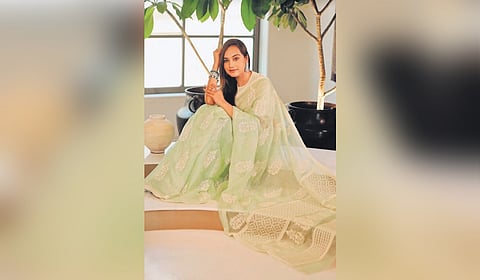
This season, Singhania has launched a new collection of Kota saris. The six-yarders are all in pastel hues, perfect for India’s increasingly hot summers. But they’re not just plain vanilla or even strawberry. Each of the saris in the collection is embroidered and embellished, ready to make the transition from a day in the office to a night out on the tiles.
The base is handloom Kota silk that’s been block-printed with floral motifs. These motifs are then embroidered with delicate white thread and embellished with pearls. The designer says it takes 20 days for each woven sari to go through the dyeing, printing and embroidery process. In the final stage, artisans sew the pearls onto the fabric. What is it they say about the pearl being the queen of gems and the gem of queens?
www.vidhisinghania.com