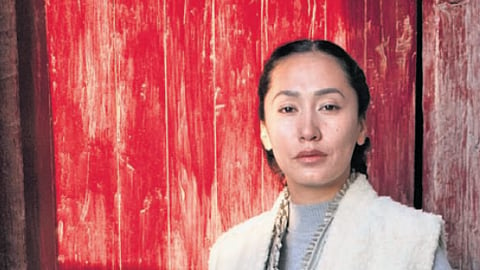

In the icy vastness of Ladakh’s cold desert, where Changra goats graze at altitudes most humans can barely breathe, a small miracle of craft and courage is taking shape. Amidst prayer flags fluttering in the wind and ancient looms creaking with history, Looms of Ladakh is redefining luxury—and rewriting who gets to own it.
At its heart is Abhilasha Bahuguna, a woman with a mind for economics and a soul tethered to the loom. “Our goal is to empower women to take ownership of their craft and actively participate in the market,” she says.
For too long, India’s cultural policy has celebrated its heritage crafts with little to show for the hands that keep them alive. GI tags and glossy awards may elevate the craft, but the craftswoman? Often invisible. That’s the imbalance Bahuguna set out to challenge when she traded the foothills of Dehradun for the high-altitude silence of Ladakh.
“After my husband saw artisans selling Pashmina socks and gloves, I realised Ladakh Pashmina is a shared dream—one that needs sustained markets and consistent upskilling for higher value,” she recalls.
Drawing on her training in development economics, she imagined something bold: a cooperative

Woven warmth into the bones of their communities—by May 2017, the Looms of Ladakh Women Cooperative was no longer just a vision, but a movement. And it wasn’t easy. Local power structures pushed for wage labour; government agencies nudged the women toward self-help groups, stripped of agency. But Bahuguna and the women stood firm. Their model would be different: artisan-owned, artisan-led, artisan-proud.
Using weaving techniques passed down like family heirlooms, every shawl, stole, and scarf emerges from the loom soaked in story. The raw material—pashmina so soft and light it feels like breath—is combed by hand from the undercoat of Changra goats, then spun, dyed with natural hues, and woven with patience and pride. “We want our customers to know that what they wear has a story woven into it,” Bahuguna says.
Under their luxury label Aikyamatya—meaning “consensus”—they’ve joined hands with artisans across Chamoli, Odisha, and Kanchipuram through the Four Harmonious Friends network. It’s an alliance built not just on shared profits but on shared purpose, co-creating and co-branding across regions. And the market has noticed. “In summer, high-purchasing-power Indian clients and expats are our key buyers; in winter, our products retail through select multi-designer platforms and private showcases,” Bahuguna notes.
Their clientele reads like a who’s who of India’s cultural and social elite—Kapil Dev, MS and Sakshi Dhoni, designer Rina Singh, Sudha Murthy, and Radhikaraje Gaekwad, the Maharani of Baroda.
Today, Looms of Ladakh includes over 450 women weavers. Each works with wool from her own herd, ensuring that authenticity is a birthright. “The success of Ladakhi Pashmina lies not just in the quality of the wool, but in the identity it carries,” Bahuguna reflects. “We’re not just making products,” she says. “We’re building futures.”