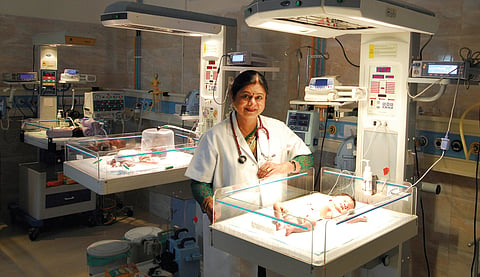

Watching expressions flit across Dr Kamala Selvaraj’s countenance as she talks about her work seated in her study at the GG Hospital, one cannot help recalling the yesteryear actor and her father the late Gemini Ganesan who dominated the Tamil world of celluloid in his indomitable and inimitable fashion. “You know,” she points out seriously, “my father always wanted to study medicine and become a doctor. He would have become one if fate had not willed otherwise. He was a perfectionist and I have imbibed this quality from him. I am proud to say that to fulfill my father’s wish, there are now nine doctors in our family, including my children.” The name GG stands for Gemini Ganesan, as he first bought the land for his daughter on which the hospital now stands.
Her name today is synonymous with test tube babies. She recalls every step of the way that led her to her goal. “It’s been a journey of sweat, toil and tears,” she admits candidly. “The initial struggle began when my sister and I were refused admission to the Madras Medical College as we belonged to the ‘forward community’ and worse still we were Brahmins. A chance meeting between our father and one Mr. Pai from Manipal secured us admission into the Kasturba Medical College at Manipal after paying a good sum as donation,” says Selvaraj.
The idea to learn more about test tube babies inspired her after she read an article about it in a newspaper. “After that I did some research and got myself invited by Dr Carlwood to the Monash University in Melbourne to attend a week-long workshop there on the first week of November in 1985. I paid a fee of `30,000 for that, but it was money spent for a good cause and I left for Melbourne,” says Selvaraj. In the university there, she got her first lesson of in vitro fertilization (IVF). She had to rely on record books and her practical classes to understand the complexities of the subject as she had difficulty to comprehend the lectures due to the American-Australian accent there.
As the cost of the equipment required for the IVF laboratory was too expensive, she abandoned the idea of setting up one and returned to India in a state of depression. “Expectations were high from people here and I was amazed to see a long queue of women waiting outside my consultation chambers waiting for the ‘miracle’ to happen. That was the turning point of my life,” claims Selvaraj. She was then determined to set up her IVF lab to produce test tube babies for childless couples and make them happy no matter what the odds were.
After that there was no looking back. From getting over her fear of handling mice for her experiments to getting the door of the IUI (Intra uterine insemination) department slammed in her face when she wanted to witness the procedure by a reputed doctor in the Richard Ash Centre in the US in 1987, the trials and tribulations she had to contend with were plenty. There, however, she met another doctor who was also contemplating on starting an IVF lab and to her delight offered her the list of equipment that would be required for that purpose. Her tryst with fate continued later in October of the same year, when stranded at Frankfurt airport, she battled her way to London in spite of a hurricane and managed to reach the stores to check the supplies and collect the equipment before they closed for the day.
Gradually, with fundings from the bank and also her own resources, as by then she had an established practice as an obstetrician-gynaecologist, she was able to obtain all the required equipments and set up her own IVF lab in the hospital in 1989. She had sat for hours for three days in the IVF lab of the National University Hospital in Singapore watching them prepare the ‘culture medium’, noting everything carefully and jotting the procedures in her book. “After all that hard work, my first test tube baby was delivered by Ponna Ramamurthy in August 1990,” says Selvaraj.
The baby, a girl, was named Kamala Ratnam after her, but she says the crowning jewel is that South India’s first test tube baby, born in GG hospital marking a milestone in Assisted Reproductive Technology (ART), is an IT graduate who conceived naturally and delivered a baby girl on October 7 last year in the same hospital. This is testimonial evidence that test tube babies can deliver through normal conception and lead a normal life. Today Selvaraj has orchestrated the birth of more than 1,000 successful test tube babies using the latest technology of the ART method. She is the recipient of several awards—Best Lady Doctor (a state award given in Chennai) in 1993, Rajiv Gandhi Memorial National Integration Award in 1995, and Seva Ratna Award in 2001.
She has also a number of publications to her credit. In 2002 she earned her PhD for her thesis on ‘Premature ovarian failure and its management’. Today, her hospital, of which she is the associate director, is a 75-bed, four-storied building covering all aspects of gynaecology, obstetrics, cardiology and general medicine. It deals with all aspects of infertility and ART. Selvaraj’s tremendous drive, singleness of purpose, tenacity of spirit and the determination to proceed serve as a pilgrim staff not only for those on a journey to success in the medical field but for others too who want to ‘make it big’ in their lives.
