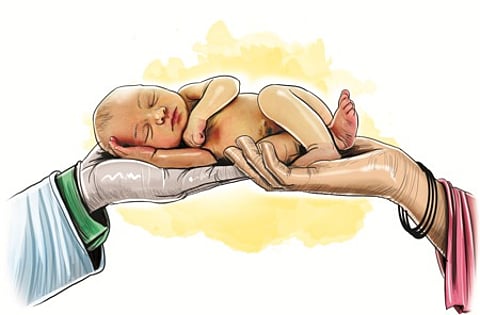

CHENNAI: A decade after the UK legalised mitochondrial donation—a pioneering reproductive technology that combines DNA from three individuals—questions are emerging about its effectiveness, safety, and the overall patient experience.
Developed by scientists at Newcastle University, the technique uses nuclear DNA from the intended mother and father, along with healthy mitochondrial DNA from a donor egg. Approved under the UK’s Human Fertilisation and Embryology Regulations in 2015, the method has so far led to the birth of eight reportedly healthy children. The goal of mitochondrial donation is to prevent the transmission of serious genetic disorders caused by faulty mitochondria.
Mitochondria are parts of a cell that act like power stations, converting food into energy the cell can use. They are inherited exclusively from the mother through the egg cell, as mitochondria in the father’s sperm are typically not passed on to the offspring.
Results from Newcastle University, published in the New England Journal of Medicine, show that 22 women received the treatment since 2017, resulting in eight births. The technology offers new hope to families at risk of passing on inherited mitochondrial disorders such as Leigh syndrome—a life-threatening condition that disrupts the body’s ability to produce energy at the cellular level.
In mitochondrial donation, the nucleus from the mother’s egg—which holds her nuclear DNA—is moved into a donor egg that has had its own nucleus removed. This creates an embryo that contains the mother’s nuclear DNA and the donor’s healthy mitochondrial DNA (mtDNA).
This technique helps stop the transfer of the mother’s faulty mitochondrial DNA to her child, significantly lowering the risk of the child developing a mitochondrial disease.
While this is a scientific milestone, several concerns have emerged now:
Transparency: There has been a long delay in sharing outcomes and updates. Given the public investment and global interest, clearer and timelier communication is expected.
Limited Use: Although early estimates predicted up to 150 babies per year could benefit, only 32 applications were approved, and only 22 procedures carried out, leading to eight births. This raises questions about the actual reach and practicality of the treatment.
Safety Concerns: In two of the eight cases, higher levels of the mother’s faulty mitochondria were found, suggesting a risk that the original disorder could still manifest later. The Newcastle team now presents the technique as reducing—rather than eliminating—the risk of mitochondrial disease.
Patient Experience: More clarity is needed on why some approved cases did not proceed, and how families cope when treatment is unsuccessful or unavailable. The emotional and psychological toll on patients who invested time and hope into this process is significant.
Despite these issues, the birth of eight healthy children represents a real achievement in reproductive medicine. However, important questions about effectiveness, safety, eligibility, and patient communication remain. For the UK to retain its leadership in this field, future progress must be matched by transparency and responsible communication about both the potential and limits of this technology.
