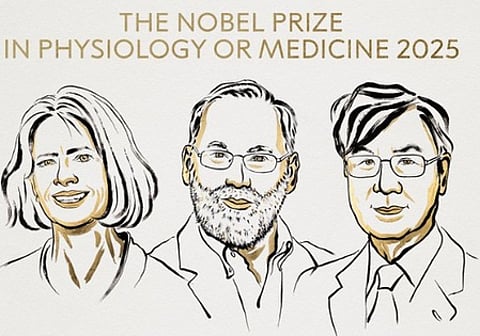

CHENNAI: The 2025 Nobel Prize in Physiology or Medicine has been awarded to Mary E. Brunkow and Fred Ramsdell from the US, and Shimon Sakaguchi from Japan, for their pioneering discoveries on how the immune system learns to control itself. Their work has unlocked a deeper understanding of how the body prevents its own defenses from turning destructive — a finding that could transform treatments for autoimmune diseases, cancer, and organ transplants.
The scientists discovered how a special group of immune cells, called regulatory T cells (Tregs), act as the body’s internal “peacekeepers.” These cells ensure that the immune system attacks harmful invaders like viruses and bacteria, but leaves healthy cells unharmed. Central to this process is a gene known as FOXP3, which acts as a switch that helps Tregs develop and function properly. When this gene malfunctions, the immune system can lose control and begin attacking the body’s own tissues — leading to diseases like type-1 diabetes, lupus, multiple sclerosis, and rheumatoid arthritis.
In simple terms, this breakthrough explains how the immune system “knows when to stop.” Just as brakes prevent a car from speeding out of control, regulatory T cells keep the immune response balanced. Without them, the system can either go too far and attack healthy cells, or hold back too much, allowing infections and cancers to grow.
Think of your immune system as a vigilant security force that protects your body from invaders like viruses and bacteria. But just like any good security team, it also needs rules to make sure it doesn’t attack its own citizens — in this case, your healthy cells.
Earlier research had shown that during early development, the body removes immune cells that might attack its own tissues. This process, known as central tolerance, acts like a training school for the immune system.
The breakthrough
The new Nobel-winning discovery reveals that there is a second layer of control, known as peripheral immune tolerance, which operates outside this training system — in the body’s tissues. In this layer, a special type of cell called a regulatory T cell (Treg) works like an internal “brake.” These cells monitor immune activity and prevent overreactions that could damage healthy cells.
At the heart of this process is a gene called FOXP3, which acts as a key switch for the development and function of regulatory T cells. If this gene is defective, the “brake system” fails, and the immune system can mistakenly attack the body — leading to autoimmune diseases such as type-1 diabetes, lupus, multiple sclerosis, and rheumatoid arthritis.
In simple terms, the scientists discovered how the immune system keeps itself under control and why this mechanism sometimes breaks down. Their findings explain why some people develop autoimmune diseases and open new doors for potential treatments.
Why it matters
This breakthrough has far-reaching implications for medicine and treatment:
Autoimmune disease therapy: Strengthening regulatory T cells could help stop or even reverse the body’s self-attacks in diseases like lupus or diabetes.
Cancer treatment: In cancer, the immune system is sometimes too restrained. Adjusting this control could help it better target and destroy tumors.
Transplant success: Regulating immune activity more precisely could help prevent organ rejection.
Smarter immune therapies: Instead of broadly suppressing the immune system, doctors could fine-tune it — strengthening or calming it as needed.
Challenges
While the discoveries are groundbreaking, turning them into real treatments will take time. Manipulating the immune system’s brakes carries risks — too much control can make people vulnerable to infections, while too little can worsen autoimmune attacks. Many of these potential therapies are still being tested in clinical trials, and human biology often proves more complex than lab models.
Despite these challenges, the Nobel-winning research marks a major leap in understanding how the immune system maintains balance — a finding that could reshape the future of treatments for both autoimmune diseases and cancer.
The discovery has opened new doors for medical research and treatment. Scientists are now exploring ways to strengthen regulatory T cells in autoimmune diseases, or temporarily weaken them in cancer, to help the immune system fight tumors more effectively. It could also help in improving organ transplant success by preventing rejection.
Medical experts say the Nobel-winning work highlights how understanding the immune system’s self-control could lead to safer, more precise therapies in the future. While practical applications will take time to develop, this discovery lays the foundation for a new era in immune-related medicine.
