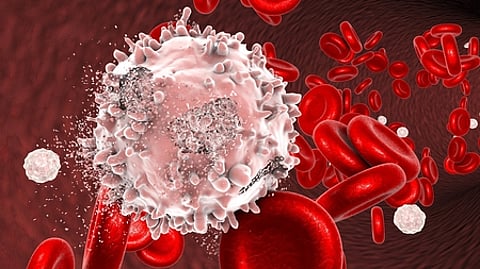

HYDERABAD: Scientists at CSIR-Centre for Cellular and Molecular Biology (CCMB) have discovered how white blood cells can adapt their internal skeletons to combat pathogens.
The team of scientists at CCMB led by Saikat Chowdhury discovered how cells can form flat protrusions in the direction of the pathogen and swim towards it. The protrusions are formed within microseconds, thus adapting the internal skeletons for the defence mechanism. The study was published in Natural Structural & Molecular Biology.
Researchers said that the cell’s shape depends on a dense, branched actin network found near the cell membrane. Actin are structural but very dynamic molecules known for their ability to push on the cell membrane. When the cell needs to make a new protrusion, it must create a new meshwork of actin that can push in the desired direction of movement.
Scientists discovered that cells can generate new actin mesh from a pool of actin monomers in a tightly regulated manner via a protein called SPIN90.
They found that SPIN90 works as a dimer with another protein complex - Arp2/3. This initiates the growth of new actin filaments starting from the SPIN90-Arp2/3 complex, in two directions - always separated by about 150 at the starting point. These new filaments serve as scaffolds for building a new branched actin meshwork. Thus, it creates a new protrusion, gives a new shape to the cell, or directs its motility.
Chowdhury said, “SPIN90’s ability to build actin filaments in two directions may explain how cells rapidly create adaptable scaffolds. This can help us understand how cells remodel themselves in health and disease, including cancer, immune disorders, and wound healing.”
