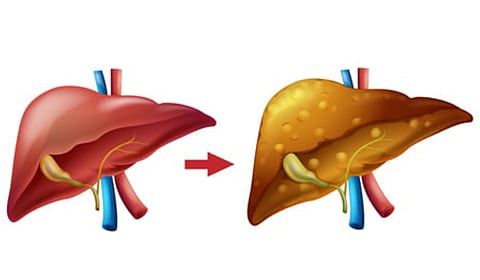

NEW DELHI: Nearly 40 per cent of participants in the Phenome India-CSIR Health Cohort could be affected by metabolic-dysfunction-associated steatotic liver disease (MASLD), according to a study published in The Lancet Regional Health Southeast Asia journal.
The study examined more than 7,700 adults recruited from 37 laboratories of the Council of Scientific and Industrial Research (CSIR) across 27 Indian cities, including permanent staff members, employees, retirees, and their spouses.
Significant fibrosis, defined as liver stiffness measurement, was found to be more frequent in MASLD cases compared to those without MASLD.
Researchers from CSIR institutes, including the CSIR-Institute of Genomics and Integrative Biology, reported that the overall age-adjusted prevalence of significant fibrosis was 2.4 per cent, clustered in older adults aged 60 and above, as well as in those with diabetes or obesity (BMI 35 to under 40).
The ‘Phenome India’ project is a pan-India, long-term study aimed at developing an enhanced prediction model for cardio-metabolic diseases, especially diabetes, liver diseases, and cardiac diseases, according to a Ministry of Science and Technology press release dated June 3, 2024, which marked the collection of more than 10,000 samples.
“Of 10,267 individuals screened, 7,764 were included, 3,712 (47.8 per cent) fulfilled MASLD criteria, corresponding to an age-adjusted prevalence of 38.9 per cent,” the study authors wrote.
“MASLD affected over one-third of participants. Community-based awareness and targeted public health interventions across diverse geographical and socio-cultural settings in India may help curb the rising burden,” they said.
The MASLD group had a higher proportion of overweight and obese individuals, significant liver fibrosis, higher mean HbA1c values (average blood sugar levels over the past 2–3 months), and a higher prevalence of dyslipidemia compared to those without MASLD, the study found.
Obesity was identified as the strongest risk factor for MASLD. Diabetes, dyslipidemia, and elevated blood pressure further increased MASLD risk, the researchers said.
Age-adjusted prevalence of MASLD showed wide geographical variation, ranging from 27 per cent in Thiruvananthapuram, Kerala, to nearly 50 per cent in Roorkee, Uttarakhand, and Bhopal, Madhya Pradesh. Major metropolitan centres such as Delhi, Bengaluru, Pune, Hyderabad, and Chennai showed “intermediate prevalence,” the researchers noted.
They added that the high prevalence of MASLD and liver fibrosis in India represents an urgent public health challenge.
“Our findings highlight hotspots (e.g., higher fibrosis in Assam) and demographic vulnerabilities (e.g., elderly, diabetic, or obese individuals), with an increase of cardiometabolic risk factors in certain geographies, providing novel actionable evidence,” the authors said.
