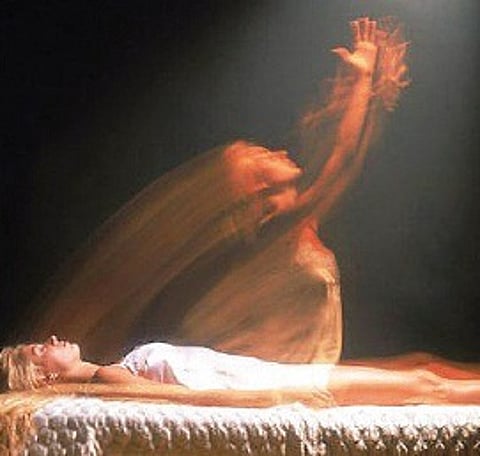

Children, the desire to survive and the fear of death are natural. Humans fear death because, with death, we lose everything we’ve worked so hard to accumulate. We can overcome this fear, but to do so we must learn to face death while we are living.
Two patients were on their deathbed in a hospital. One was a famous writer, the other a 12-year-old girl. The doctors were trying hard to save the writer, but none of their treatments were working. The physical and mental toll of his ordeal reflected in his face. He started to wail, “What will happen to me? I see nothing but darkness!”

The little girl also knew death was coming for her, but she was very cheerful. Her face radiated with her smile. The doctors and nurses were surprised. Thinking of the writer’s torment, they asked the little girl, “Child, you smile as though you are totally unaware of the fact that you are dying. Are you not afraid of dying?” She innocently answered, “Why should I be afraid of death when my most beloved God is right next to me all the time? I can hear Him calling me, ‘My child, come to me.’” A few days later, when she passed away, there was a smile upon her tiny lips. If we want to meet death fearlessly with a smile, we should either have the innocent faith of this girl or we must think, “I am not the body, I am Self. There is no death for the Self.”
The following is a story from the Upanishads: Uddalaka, a great sage, had a son named Svetaketu. At 24, after years of studying in his guru’s hermitage, Svetaketu returned home. Uddalaka sensed his son’s false pride and wanted to correct him. One day he asked him, “Son, I think you feel you’ve mastered every form of knowledge on the face of the earth, but have you learnt that knowledge by which what is unheard is heard, what is not understood is understand, and what is unknown is known?”
“What is that knowledge, father?” Svetaketu asked. His father replied, “Just as by one lump of clay everything that consists of clay is known, my child, so too it is with that knowledge, knowing which one knows all.” “It could be that my revered teachers were ignorant of that knowledge. Father, can you please enlighten me?” “So be it,” said the father. “Bring me a fruit from that yonder fig tree.”
After asking him to divide the fruit, Uddalaka said, “What do you see there?” “Some seeds, father, exceedingly small,” his son replied. The sage asked his son to divide one of the seeds and said, “What do you see there?” “Nothing at all,” came the reply.
The father said, “My son, that subtle essence that you cannot perceive—from that has arisen this huge banyan tree. That which is this subtle essence, of its being is the universe. That is True, that is the Self. That thou art, O Svetaketu!”
Everything arises out of this so-called nothingness. That indeed is the mystery of life. We emerge out of the infinity of nothingness. Even while we live in this world, we are a nothing. At the end, we disappear back into this sea of nothingness. That nothingness is not a void but pure undivided consciousness, that which the scriptures call sat-cit-ananda—pure existence, pure consciousness, pure bliss. In reality, we come from that totality of consciousness, and we go back to that same totality.
The writer is a world-renowned spiritual leader