
Hey mister, are you from India?”, asked the coachman of a passing horse-driven cart along the banks of the Nile River to me. I was surprised; it was my first evening in Cairo, the capital of enticing Egypt that has charmed people over generations with its fascinating history and character.
Reciprocating my friendly nod, his following call was even more surprising.
“Namaste Shah Rukh Khan,” he said loudly. Though it may be a common gesture granted to anyone with the look and like of an Indian, I still felt flattered and waved at him with a Mai hoo naa smile.
Bollywood has spread its wings to Egypt as well. Shah Rukh, Amitabh and Hritik are no strangers to them; thanks to easy availability of Hindi film DVDs with Arabic subtitles which have now entered the homes of even ordinary Egyptians. “We find them very entertaining,” said Sameer, a young waiter at a restaurant, who is a great fan of Kareena Kapoor. And they use their filmi knowledge to draw attention of Indian tourists for business. Indian cuisine is also popular. Ramses Hilton, the Nile-facing opulent hotel where I was a guest, has an Indian restaurant called Maharaja. However, the Mughal Room Restaurant at the Mena House Oberoi Hotel in Giza is the best.
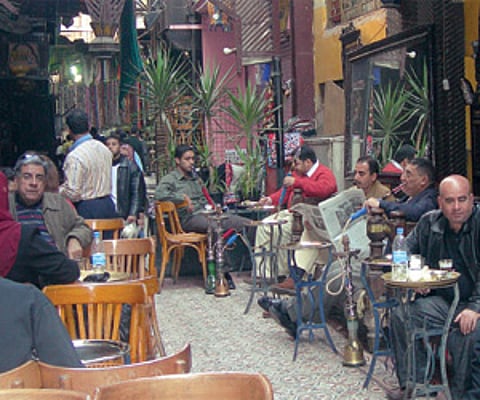
“But the relationship with India goes back to the time of Nasser and Nehru, they both fought for their country’s independence and shared many ideologies,” said retired academic Abdul Gamal while having coffee at El Fishawy’s, the oldest café inside the Khan al Khalili bazaar in the old but captivating part of the city, often termed as Islamic Cairo. Gamal also offered me sheesha (Hubble Bubble) to smoke, an inherent part of café culture in the Islamic Middle East, but being a non-smoker I had to decline with extreme politeness as all Arabic people, though very hospitable, can get offended if their offer is turned down.
Cairo, being an Islamic city, is dotted with several architecturally splendid mosques, the minarets of which dominate the city’s greyish skyline. Amongst all, the most impressive is perhaps the 9th-century Mosque of Ahmad Ibn Tulun, arguably the oldest and largest in terms of land area. Built in an Iraqi style, it served as a location for the famous James Bond movie, The Spy Who Loved Me. While exploring the city’s Islamic monuments, I learnt from my guide Shyma that as mosques surfaced almost six centuries after churches, they adopted many features from their predecessor. She also pointed out that mosques with minarets shaped like a pointed pencil were built by the Turkish rulers, notable among them in Cairo being the 19th-century Mosque of Muhammad Ali.
Cairo is a city full of attractions which includes churches as well, because of its considerable Christian population. We visited the Hanging Church and St Sergius Church where it is said that baby Jesus took refuge with Joseph and Mary during their period of exile from Israel. The Egyptian Museum is another must see attraction that offers over 1,00,000 relics and antiquities from almost every period of ancient Egypt.
However, the main draw for tourists to Cairo is the Pyramids which were built as burial tombs of the Pharaohs, the ancient Egyptian Royals. They are limestone masonry structures, the shape representing the primeval mound from which the Egyptians believed the earth was created. Many of these structures, over time, got veiled under the sands of the legendary Sahara desert and were excavated and introduced to the modern age only towards the end of the 19th century. However, archaeologists believe that all have not been discovered and no one knows what secrets the sand may be hiding.
Egypt has over 100 pyramids, the oldest among them being the tomb of Djoser, the second king of the 3rd dynasty who ruled between 2630-2612 BC. Located at Saqqara near Memphis, Egypt’s ancient capital, this particular monument was not a true pyramid with smooth sides and a point at the top or rather its sides rose to the top in steps and hence this structure is famously known as the Stepped Pyramid.
However, when the world talks about the famous pyramids of Egypt, they all mean the Great Pyramid of 4th dynasty King Khufu at Giza near Cairo. Built around 2570 BC, it’s the only survivor of the Seven Ancient Wonders of the world and largely dominates the nation’s tourist trade. Not this one, but eight other pyramids of varying sizes, tower over the Giza plateau. Noteworthy among them are the Pyramids of Khufu’s son and grandson King Khafre and King Menkaure, the rest belonging to the royal queens.
“Jaw dropping” may be the most appropriate word to express the first visual impact. I was simply awestruck by the silent beauty of the colossal structures standing imposingly under the blue sky against the flat ground of the desert. “The 146-metre-high Great Pyramid remained the tallest man-made structure in the world for around 3,800 years,” said Shyma. It took a workforce of 1,00,000 to complete the monument with a base length of 230m in 20 years, using 2.3 million limestone blocks. The other two pyramids are smaller in size.”
“But why does the Pyramid of Khafre appear to be bigger than the Great Pyramid?”
I kept seeing the structures from different sides and corners and was amazed by their perfect geometry, accuracy of lengths and angles. I tried hard to imagine how these monuments of unprecedented scale were built with such prowess and precision. Like everyone else’s, my imagination failed but made me understand why these pyramids for ages have been perceived as a mystery.
Although there is not much to see inside, passing through the ancient chambers with your thoughts wide open is an incredible experience. Do not go in if you suffer from claustrophobia. Undoubtedly the draw for my trip to Egypt was the pyramids; I touched and hugged them, climbed them and gazed at the change of colour on stone at different times of the day. In the evening, I did not miss the spectacular sound and light show which illuminates the monuments in different colours as you hear the story of the ancient civilisation that evolved along the Nile. I even woke up in the morning with the pyramids. From my 27th floor hotel room in Cairo downtown, I could see the pyramids 20 km away, glowing under the golden rays of the morning sun as they have for the past forty centuries.
All guide books say that Cairo is a city of scams which I have to contradict. Yes, like India, some of the people are very poor, but I found them honest and courteous. I was never charged extra by any taxi driver when travelling on my own; neither was I forced to buy anything overpriced, though bargaining is the fun part of shopping in Cairo.
The Egyptian guy sitting next to me in the plane, before landing presented me with a 10 Egyptian Pound note writing his address on it, as a memento of our brief acquaintance and also in case I needed help in the new city. Before marking my footprints in Egypt, I was assured that the people here are welcoming.
sandiphor@hotmail.com
Factfile
Getting there: Fly Etihad Airways (www.etihadairways.com) from Chennai to Cairo with an aircraft change in Abu Dhabi. Accommodation: Stay at the centrally located, Nile River facing Ramses Hilton Hotel (www.cairo-ramses.hilton.com)
Currency: Egyptian Pound is the local currency, though US dollars are widely acceptable.
Visa: Visa on arrival at Cairo international airport is available, alternatively it can be obtained from Egyptian Consulate General in New Delhi (www.mfa.gov.eg)