
The incense smoke fills the dimly lit eatery wafting through the delectable idli dipped in sambhar and the bittersweet coffee as groggy commuters await the nascent twilight to blossom into a cloudless sunny morning. The bus stand of Ranebennur gradually wakes to a cacophony of noises— hawkish conductors announcing various destinations, music bellowing from a brightly decorated shop, the brush of a broom, the shuffling of impatient travellers. For the past few days, the monsoon showers have abated ushering in a fledgling autumn as a month of festivities hides around the corner. Nature too joins this revelry and this is evident as one deviates from the highway connecting Bangalore to Haveri and travels along the serpentine roads threading the countryside. In the villages, surrounded by lush green fields reflecting the warmth of the morning sun, farmers walk to their fields and neatly dressed kids bundle into school buses. Chaudayyadanapura is one such sleepy settlement endowed with a lazy charm intrinsic to Indian villages; its claim to fame, however, is the Mukteshwara Temple, inviting reverence and faith from devotees and curiosity from budding historians and art lovers.
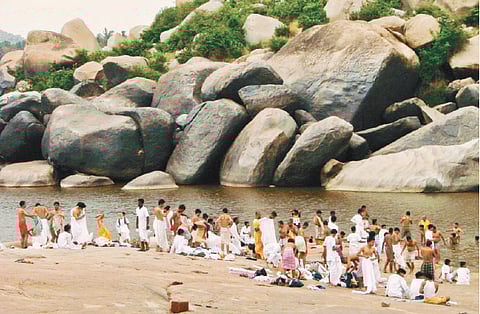
The sunshine filters through the tall coconut trees and illuminates the temple complex which comprises a main single cella structure, several smaller temples and a keerthistambha. Beyond the parapet wall, the gracious Tungabhadra flows westwards and then turns to the north, the temple village of Kuruvatti sits on the opposite bank. White cranes skim the river surface and land on inundated shrines resisting the ample flow of a river fed on the monsoon rains. A fine example of the Kalyani Chalukyas style of architecture, it is an ornate expression of art with elaborate sculptures spanning the outer walls, doorways and ceilings of the temple. Intricate depictions of kirtimukhas (fierce monsters), floral designs, miniature shikharas (towers), gods and goddesses, musicians, dancers and blooming lotuses are abundant. These carvings are very impressive around the doorways where the minute designs retain a fading red colour. The morning rays paint the shikhara golden, accentuating the layers of sculptures rising to the waterpot or kalash. The splash of water breaking on the bank, the tolling of a bell, the rustling of leaves, and the chatter of monkeys enliven this journey back to the past. This temple is also important from an archaeological perspective as the inscriptions found here shed light on many historical events like the spread of Veerashaivism and erstwhile kingdoms of Karnataka and central India.
Travelling north from Chaudayyadanapura, one comes across the crossroads town of Guttal. The dusty and boring character of present-day Guttal is in stark contrast to its noble past when it was a prominent centre of power in the 11th century and was ruled by the Guttas, a feudatory of the Chalukyas. Further north is the village of Galaganatha at the terminus of a paved road which peters out to a mud track as it approaches the west bank of Tungabhadra, close to its confluence with the river Varada. The Galageshwara Temple, which faces east towards the river, is a towering structure with a unique pyramidal buttress around the vimana (shrine). Based on the architecture and inscriptions found, its foundation can be attributed to the Kalyani Chalukya king Jayasimha II in the 10th century. The mid-day sun beats down relentlessly reined in by the refreshing air whipped by the cool grey river. It roams freely in the high open hall supported by rounded pillars where many decent sculptures of Vishnu, Saraswati and Surya are placed. A caretaker trims a colourful hedge in the courtyard; soft green grass and the shade of a large peepal tree whose branches seem to reach out for the temple tempts the weary. The village lanes are deserted, a few goats wander aimlessly around a hand pump chased by a couple of bedraggled kids. The serenity is intoxicating and coaxes the traveller to submit to this undisturbed moment of peace.
A back-breaking ride on an unpaved dirt track running south along the Tungabhadra brings one to the village of Havanur. Decaying bastions and broken rampart walls, which command a view of the ploughed brown fields on the bank of the river, suggest the existence of a medieval fort. Continuing along the river towards Guttal, it is easy to overlook the Someshwara Temple in the village of Haralahalli. This is a trikuta (a temple with three shrines) with three shikharas, the north vimana bearing scars of decay and repair work, rising against the blue evening sky dotted with cotton clouds. The temple is ornamented with exquisite carvings of elegant deities bordered by fearsome kirtimukhas, decorated pillars, dancing troupes and mithuna (erotic) figures on the walls of the porch. An informed caretaker patiently explains the history of this region and the meaning of many interesting sculptures adorning the walls.
Karnataka’s temples are not only brilliant masterpieces of artistic expression, but their scenic locations ensure that sceptical visitors at least savour the delights of an Indian countryside. These treasures of Chaudayyadanapura, Galaganatha and Haralahalli hark back to the heydays of temple-building traditions in South India and though they have been ravaged by time, their glory remains unperturbed. The vibrant settlements of yore, which flourished by the sweet water of the Tungabhadra, have been grounded to dust, but the temples serve as a constant reminder of an era which has faded into oblivion.