
A teenager wearing black shorts and a pink T-shirt is about to start hiking to the peak of the scenic Seongsan Ilchulbong Tuff Cone. Standing at the base, entry ticket in hand, she looks up at Seongsan, located on the eastern side of Jeju Island in South Korea, which is bathed in hues of green courtesy the trees growing on it. There are also scattered patches of grey rock jutting towards the sky. In the distance, a sea of people climbing the peak merges with the green grass.
From the starting point, it doesn’t look like a difficult climb. However, after a few minutes, the steep incline challenges one’s stamina. As one stops mid-way, the coastal topography awes the mind: the green vegetation of Seongsan—also known as ‘sunrise peak’—ends in the sea, while the city’s multi-coloured buildings and vehicles offset the grey-coloured tar roads. There are also panoramic views of Mount Hallasan, a shield volcano, whose summit is the highest point in the country.

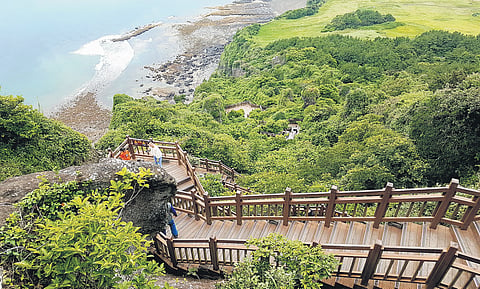
Further ahead lies the Deung Gyeong Dol Rock, formed by volcanic ash. The climb back down is rather easy. The way is streamlined using another route comprising a series of wooden stairs. The sea and Jeju city give company to the hikers during their descent. The shops located at the base are doing brisk business. Bottled water is flying off the shelves. The shop selling ice-cream is doing particularly well. Most of its sale is from the orange-coloured local favourite tangerine-flavoured ice-cream.
The next location on the geoheritage trail of Jeju is Manjanggul Cave, South Korea’s first cave to be given a natural monument status. Don’t let its inconspicuous façade deter you from entering: where you end up walking on solidified lava. The walls on either side are covered with brown lava flowstones. A little ahead, on the floor, is a peculiar greyish-green formation. It has a rather unusual name—Lava Toe, as it resembles the toe of an elephant.
Then there is the Hallim Park. It is Jeju’s stone and bonsai garden and has a zen vibe to it. From here, walk to the Ssangyong Cave, formed by the eruption of Mount Hallasan. The word Ssangyong means two dragons and the formation of the cave tells you why. The solidified lime on the ceiling resembles two dragons, framed in time. South Korean legend also mentions that the God of Wisdom lived in Ssangyong. Little wonder that you would find a few locals circumambulating an underground pillar to please the deity. Wisdom or not, it is an enchanting trail, worth a visit.