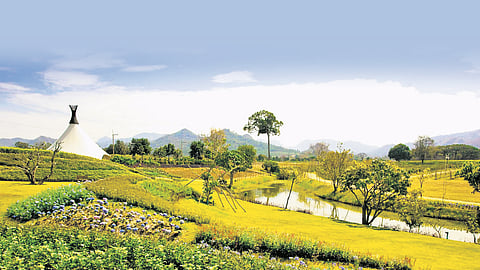

Two and a half hours northeast of Bangkok, the skyline loosens its grip. Highways slip into rolling hills; the air grows cooler, scented faintly with grass and rain-warmed soil. This is the threshold of Khao Yai National Park—a UNESCO World Heritage-listed reserve known for elephants, hornbills and monsoon forests.
And then, just beyond the tree line, something improbable appears: vines. At PB Valley Khao Yai Winery, neat rows of Shiraz and Chenin Blanc ripple across nearly 300 acres of cultivated land within an 800-acre estate. Established in 1997 by Dr Piya Bhirombhakdi of the Boon Rawd Brewery family, PB Valley is widely recognised as Thailand’s first commercial winery and remains the largest vineyard in the region. In a country better known for Singha beer and coconut groves, the sight of grape clusters darkening in the tropical sun feels almost cinematic. Even the light here is different—golden and low against the foothills. Stone buildings hold the day’s warmth. Stainless steel fermentation tanks glint where you might expect longtail boats. The landscape feels part Tuscany, part Isaan plateau, entirely unexpected. “Winemaking in Thailand means learning to listen to the climate,” says Bo, the estate guide, as we walk between vines of Tempranillo, Cabernet Sauvignon, Colombard and Shiraz. Unlike Europe’s single annual harvest, tropical viticulture demands ingenuity. The growing season is shorter; vines must be carefully pruned to control yields. Harvest typically falls between February and March, during the dry season, when humidity dips and sugars concentrate.
Between the vines, avocado and dragon fruit trees flourish. Durian hangs heavy in the orchard. This coexistence of wine grapes beside tropical fruit is a reminder that Khao Yai sits just 200 kilometres from Bangkok, not Bordeaux.

Inside the facility, the atmosphere shifts from pastoral to precise. Pressed grapes release the juice that begins cloudy before settling overnight. For white wines, skins are removed almost immediately to preserve brightness; reds ferment with their skins for up to two weeks, extracting colour and tannin. Rosé rests somewhere between—a brief communion with its skins, just long enough to tint the wine a luminous blush. Temperature-controlled stainless steel tanks manage fermentation in the tropical heat, a necessity rather than a stylistic flourish.
The tasting room overlooks the valley. Glasses catch the afternoon sun. A Chenin Blanc offers citrus and green apple; Colombard leans floral and light; Shiraz carries spice shaped by warm nights and cooler hilltop breezes. The 2024 Rosé feels particularly suited to its latitude—fresh, gently aromatic, a wine made for lingering lunches.
Lunch unfolds at The Great Hornbill Grill, set amid the vines and named for one of Khao Yai’s most iconic birds. The restaurant seats 150, its terrace framing the vineyard in wide cinematic sweeps. The menu bridges terroirs: Miang Bai Ngoup—vine leaves stuffed with local fillings—nods to both vineyard and village. Pad Thai PB arrives fragrant with tamarind and river lobster. Larb Pla Ta Pian crackles with herbs. Wood-fired pizzas and grilled meats meet their match in estate reds, while crisp whites cut through spice and seafood with ease.
Beyond the estate gates, Khao Yai has quietly become a weekend enclave for Bangkok’s urbanites. Flower farms bloom in improbable colours. A small chocolate factory perfumes the air with cacao. Primo Piazza offers a whimsical Tuscan façade against Thai hills. Yet the vineyard remains the most disarming sight of all.
Thailand’s most celebrated horizons may be found at the sea, but here, in the shadow of a national park, another landscape seduces—one that smells of fermenting grapes and warm earth, tastes of rosé against spice, and feels like a secret carried on the wind from the hills.