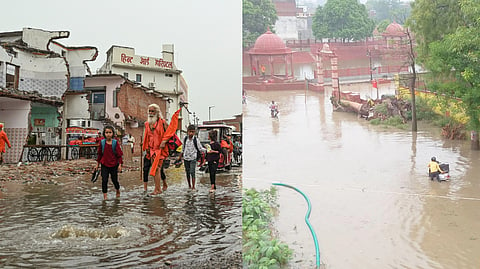

LUCKNOW: The real face of the set-up of the temple town of Ayodhya, otherwise adorned with wide clean roads leading to the upcoming temple of Lord Ram on Shri Ram Janmabhoomi premises, was exposed by the first few spells of pre-monsoon rains on Wednesday morning.
The temple town was left grappling with severe infrastructural challenges as rains led to collapse of newly-built infrastructure, caving-in of roads and inundation of streets.
While exacerbating existing issues of waterlogging owing to the narrow lanes and clogged drains, the downpour revealed the reality of 13-km long and widened Rampath, the major arterial road leading to the upcoming temple, as it caved in at various points in between the Vidya Mandir School and District hospital.
However, the authorities concerned responded by repairing the patch deploying JCB machines.
The PWD authorities attributed the incidents of roads caving-in to execution of construction works in a haste.
“It takes quite some time for the layers of soil beneath the metallic road to get properly compressed and solidify naturally. But since the construction work was carried out in a haste at the time of consecration, there was no time for the soil beneath to solidify,” said a senior PWD official seeking anonymity.
At the same time, the PWD authorities also clarified that since the construction of ‘Ram Path’ was done under a five-year agreement with the firm which has constructed the road, any damage to the road would be repaired by the construction firm during the five year period."
Even the seepage in the sanctum sanctorum of upcoming temple hit the headlines but the claim was later refuted by Shri Ram Janmabhoomi Teerth Kshetra Trust on Thursday.
Meanwhile, late on Friday, The Uttar Pradesh government has suspended three engineers each from both the Public Works Department (PWD) and Jal Nigam. This action includes the suspension of an Executive Engineer, an Assistant Engineer, and a Junior Engineer, all in connection with the road subsidence issue.
Heavy rainfall caused waterlogging in parts of the temple town with locals and tourists having to wade in ankle-deep water to make their way across town.
However, the local residents of Ayodhya find waterlogging an annual phenomenon which, they claim, reveals the flawed planning and supine attitude of the Municipal Corporation of the district monsoon-after-monsoon.
The pre-monsoon showers also led the entrance to the new Ram Temple splattered as devotees were seen lined up outside it with roof missing the sheets, leaving those standing underneath exposed to the downpour.
People were seen walking through a water-logged street leading to the Ram temple after the rains.
Locals of the areas adjoining the temple premises claimed that water entered their homes and also the numerous guest houses and home stays, which have mushroomed after the consecration ceremony of Ram Lalla in January, this year.
The footfall, despite all the challenges, be it the blazing sun, sweltering heat or the heavy downpour leading to water logging, has been high in the temple town. As per the official figures, at least five crore people have thronged Ayodhya to take darshan of Ram Lalla in his abode since January, this year.
"Rain, as usual, has caused havoc. Streets are inundated. The only difference this time is that waterlogging is making the stay of tourists and devotees, who are coming in large number, difficult," said a local resident Ramendra Mishra.
Nirankar Tiwari, owning a homestay, added that the guest houses and homestays receive 2,000-2,500 guests daily. “The going has got tough for the outsiders as they are not able to get access to four-wheelers or even e-rickshaws to wade through the waterlogged lanes.”
The common refrain among the local residents is the hurried construction and careless infrastructural planning behind the mess.
"The infrastructure plan for Ayodhya was drawn in a hurry to prepare the city for the consecration ceremony. Now it is causing problems both for locals and tourists,” said Saket Singh, a student.
Meanwhile, the social media has also been abuzz with visuals of water-logging, caved in patches on Ram Path and also the collapsed wall of newly-restored Ayodhya Dham railway station.
The wall collapse incident brought the state government under severe criticism by the opposition including the Samajwadi Party.
Meanwhile, the both railway department and Press Information Bureau (PIB) rushed to debunk the claim about the collapse of a boundary wall of the newly-inaugurated Ayodhya Dham railway station.
According to PIB, the collapsed wall was not part of the new station infrastructure but belonged to the old station area. PIB clarified that the collapse was caused by excavation activities by a private individual and waterlogging in a nearby private area.
Last year, PM Narendra Modi inaugurated the revamped Ayodhya railway station ahead of the consecration of the Ram temple. The station is multi-storey building with amenities such as lifts, escalators, food plazas, shops for puja items, cloakrooms, and childcare rooms. It is a "IGBC certified green station building" railway station.
