
NEW DELHI: India and China reached a significant agreement to revert to their pre-2020 positions along the Line of Actual Control (LAC) in Eastern Ladakh. However, there remains caution until the finer details of the agreement are confirmed.
Shortly after the foreign secretary announced the agreement on patrolling along the Line of Actual Control (LAC) in eastern Ladakh, Jaishankar said the disengagement process with China has been completed.
The breakthrough in resolving the over four-year military standoff in eastern Ladakh came ahead of a likely bilateral meeting between Prime Minister Narendra Modi and Chinese President Xi Jinping on the sidelines of the BRICS summit in the Russian city of Kazan this week.
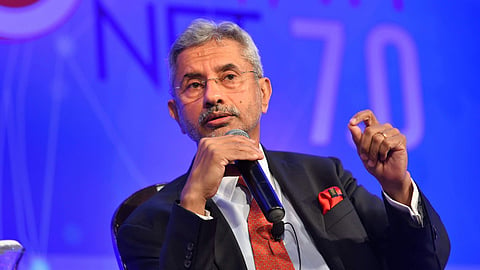
Speaking at a media summit, External Affairs Minister S. Jaishankar said, "We reached an agreement on patrolling, and we have gone back to the 2020 position. With that, we can say the disengagement with China has been completed. Details will come out in due course."
He further elaborated, "There are areas where, after 2020, they blocked us, and we blocked them. We have now reached an understanding that will allow patrolling as we had been doing until 2020."
"I think it is a good development; it is a positive development and I would say it is a product of very patient and very persevering diplomacy," the minister said.
The new agreement addresses two key friction points, Depsang and Demchok. The military has remained consistent in its interpretation of the disengagement processes from areas such as Galwan, Gogra, Hot Springs, and the north and south banks of Pangong Tso, while also asserting that this does not affect India's claim over the LAC alignment.
According to sources, previous disengagements were carried out on the principle of mutual and equal security, with no prejudice to either side's claims over the LAC. However, the standoff at Depsang remains significant, as Chinese troops have blocked access to Patrol Points (PPs) 10, 11, 11A, 12, and 13, which cover an area of approximately 952 square kilometers.
These PPs, located east of the strategic Sub-Sector North road, are not directly on the LAC but lie within Indian territory. Sub-Sector North is crucial due to its terrain, which allows large-scale armored operations. While China has multiple roads feeding this area, India has only the DSDBO road, with work underway to develop alternative routes.
The strategic importance of Depsang is underscored by its proximity to the Y Junction, which is about 20 km from the Daulat Beg Oldi (DBO) airfield.
Control over the Y Junction enables China to obstruct India's movements in the region, which also serves as a link towards Siachen and the DBO airfield.
Foreign Secretary Vikram Misri on Monday that the recent agreement came after extensive diplomatic and military negotiations between India and China over the past several weeks. "As a result of these discussions, an agreement has been reached on patrolling arrangements along the LAC, leading to disengagement and resolution of the issues that had arisen in 2020," Misri said at a media briefing.
Despite the positive developments, a note of caution was sounded by military sources and minister Jaishankar. When asked about expanding the disengagement to other areas like trade, Jaishankar responded, "It [the LAC breakthrough] has just happened. I would not go so fast at the moment."
Military sources emphasised that the situation on the ground remains largely unchanged, with troops from both sides still stationed near the 832 km-long LAC in Eastern Ladakh.
One source indicated that while pre-April 2020 patrolling involved both Indian and Chinese troops operating up to their respective lines of perception, clarity on whether this will resume will only come with the release of the agreement's finer details.
Another point of consideration is the removal of permanent constructions established post-2020, which could take several months if included in the agreement.
The Indian Army Chief General Upendra Dwivedi had spelled a word of caution that the situation remains sensitive as early as on October 1.
The TNIE reported, "The situation along the Line of Actual Control (LAC) in eastern Ladakh is currently stable, but sensitive and not normal, Chief of Army Staff Gen Upendra Dwivedi said".
India and China held two rounds of diplomatic talks in July and August with an aim to find early resolution of outstanding issues in their standoff on the LAC in eastern Ladakh.
"But when it comes to the execution on ground, when it relates to ground per se; it is dependent on the military commanders on both sides to take those decisions," the Army Chief said, responding to a question.
Army Chief General Upendra Dwivedi reiterated that "we want the situation that existed pre-April 2020 restored, whether it's ground occupation/situation, buffer zones created or the patrolling that has been planned.
Till that time that situation is not restored, as far as we are concerned the situation remains sensitive and we are fully operationally prepared to face any contingency."
As far as the Army is concerned it has stood by its stand since beginning and was reported by TNIE last year that the Army has clarified that things cannot get normal until the patrolling rights are restored.
As first reported by TNIE, the Chinese, after the clashes at Finger 4 on North Bank of Pangong Tso, moved in troops in April 2020 and it was the breach of all five agreements/understandings signed since 1993. There are 65 patrolling points with two add-ons in between, beginning from Karakoram Pass and stretching down to Demchok.
Again the TNIE exclusively reported that the Indian army has put its foot down on the issue of restoration of patrolling rights to the traditional patrolling points in the remaining standoff locations, as the talks between India and China are underway for troop disengagement in eastern Ladakh both at the diplomatic and military levels.
India and China have held regular military and diplomatic engagements to communicate their respective views and work toward restoring the pre-April 2020 conditions. There have been 21 rounds of Senior Highest Military Commander Level (SHMCL) talks and 31 rounds of Working Mechanism for Consultation and Coordination (WMCC) on India-China border affairs.
Disagreements persist due to differing perceptions of the boundary, which has been contested since the 1962 border war. The LAC itself is based on military control, leading to recurrent friction between border forces due to differing perceptions of its alignment on the ground.
The remaining standoff at Charding Nullah Junction (CNN) in Demchok, where a few tents have been pitched by the Chinese, also highlights the complex dynamics at play, as the LAC passes through CNN.
Indian forces had mobilized a significant deployment of over 68,000 troops, 90 tanks, 330 Infantry Combat Vehicles, and other artillery to forward positions in response to the Chinese troop movements in 2020.
The situation along the LAC remains a critical issue, demanding vigilance and strategic patience from both sides.
