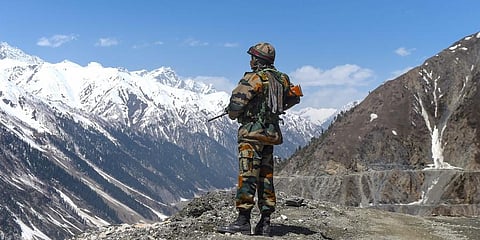

NEW DELHI: In an important sign of thaw in India-China tensions, the troops began disengaging from standoff points in Depsang and Demchok in Eastern Ladakh.
Sources confirmed that the troops have shifted back from the points near Y-Junction in Depsang and Charding Nullah Junction (CNN) in Demchok. “But the troops are in the vicinity”, said sources.
Though there is shifting from the points of standoff, there is no change in the overall troop change and the infrastructures for “only the temporary structures including the tents and shades have been dismantled”.
“The withdrawals are mutual and will follow suit. Patrolling may take some time because it will depend on the removal of the structures which came up since the April 2020 clashes.”
Defence Minister Rajnath Singh on Thursday said that India and China have been involved in talks both at diplomatic and military levels to resolve their differences in certain areas along the LAC. Pursuant to the talks, broad consensus has been achieved to restore ground situation based on the principles of equal and mutual security.
“The consensus achieved includes patrolling and grazing traditional areas. This is the power of engaging in continuous dialogue because sooner or later, solutions will emerge.”, Rajnath said.
While grazing grounds are only towards Demchok with the Nullah in the vicinity, the landform is rugged and rocky towards Depsang having the patrolling points.
The new agreement announced on Monday was about two key friction points, Depsang and Demchok.
The military has remained consistent in its interpretation of the disengagement processes from areas such as Galwan, Gogra, Hot Springs, and the north and south banks of Pangong Tso, while also asserting that this does not affect India's claim over the LAC alignment.
The disengagements, including the previous ones, have been carried out on the principle of mutual and equal security, with no prejudice to either side's claims over the LAC.
However, the standoff at Depsang remains significant, as Chinese troops have blocked access to Patrol Points (PPs) 10, 11, 11A, 12, and 13, which cover an area of approximately 952 square kilometers.
These PPs, located east of the strategic Sub-Sector North road, are not directly on the LAC but lie within Indian territory. Sub-Sector North is crucial due to its terrain, which allows large-scale armored operations. While China has multiple roads feeding this area, India has only the DSDBO road, with work underway to develop alternative routes.
The strategic importance of Depsang is underscored by its proximity to the Y Junction, which is about 20 km from the Daulat Beg Oldi (DBO) airfield.
Control over the Y Junction enables China to obstruct India's movements in the region, which also serves as a link towards Siachen and the DBO airfield.
Despite the positive developments, a note of caution was sounded by military sources and minister Jaishankar.
When asked about expanding the disengagement to other areas like trade, Jaishankar responded, "It [the LAC breakthrough] has just happened. I would not go so fast at the moment."
As TNIE reported earlier, the situation on the ground remains largely unchanged, with troops from both sides still stationed near the 832 km-long LAC in Eastern Ladakh.
As per Army Chief General Upendra Dwivedi the Army has pitched in for “the situation that existed pre-April 2020 restored, whether it's ground occupation/situation, buffer zones created or the patrolling that has been planned. Till that time that situation is not restored, as far as we are concerned the situation remains sensitive and we are fully operationally prepared to face any contingency."
As first reported by TNIE, the Chinese, after the clashes at Finger 4 on North Bank of Pangong Tso, moved in troops in April 2020 and it was the breach of all five agreements/understandings signed since 1993. There are 65 patrolling points with two add-ons in between, beginning from Karakoram Pass and stretching down to Demchok.
Both sides have differing perceptions of the boundary, which has been contested since the 1962 border war. The LAC itself is based on military control, leading to recurrent friction between border forces due to differing perceptions of its alignment on the ground.
The remaining standoff at Charding Nullah Junction (CNN) in Demchok, where a few tents have been pitched by the Chinese, also highlights the complex dynamics at play, as the LAC passes through CNN.
Indian forces had mobilised a significant deployment of over 68,000 troops, 90 tanks, 330 Infantry Combat Vehicles, and other artillery to forward positions in response to the Chinese troop movements in 2020.
The situation along the LAC remains a critical issue, demanding vigilance and strategic patience from both sides.
