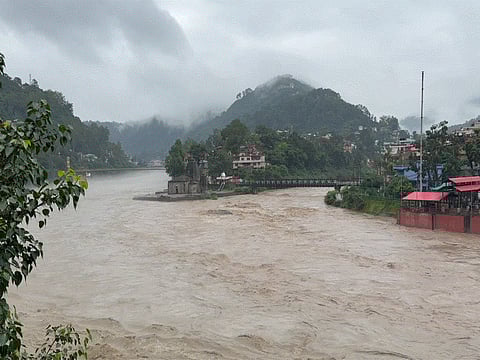

CHANDIGARH: Due to heavy rains that triggered landslides, the Kalihani river has changed its course, cutting off Bada Bhangal, a remote tribal village situated at an altitude of nearly 7,800 feet in the Kangra district of Himachal Pradesh, from the rest of the state.
Located between the Pir Panjal and Dhauladhar mountain ranges, Bada Bhangal has a population of just over 400 people. The village is accessible only on foot via treacherous high-altitude passes - Thamsar Pass which is at a height of 4,654 metres and Kalihani Pass which is at 4,800 metres. These routes typically close after snowfall in October, isolating the village for around six months every year.
Access to the footbridge over the Kalihani river has been washed away as the river has changed its course, thus blocking the pedestrian trekking route from Bir Billing in Baijnath subdivision as it has also been washed away at several places.
Mansa Ram Bhangalia, the sarpanch of the village, has written a letter to the Sub-Divisional Magistrate of Baijnath, urging immediate restoration of the pedestrian routes. He told TNIE that it currently takes three days to trek from Thamsar to reach the village, and the landslides have washed away several portions of the path. The estimated cost of repairing the approach to the bridge is approximately Rs 5 lakh. However, as the path has been washed away at several places, the damage cannot be estimated, he said.
"The supply of essential commodities including food items and medicines has been disrupted the last supply came three days back as continuous downpour is happening. The Food and Civil Supplies Department sends rations through the Kalihani route which is now impassable," he said.
An official said that efforts are underway to restore the khachar route as soon as possible. "We are closely monitoring the situation," the official added.
The village is predominantly inhabited by members of the Gaddi community, a nomadic group that grazes livestock in high-altitude pastures during summer and migrates to Bir near Baijnath in the winter. However, due to changing weather conditions, many have migrated permanently, although some still remain in the village, braving the harsh environment.
