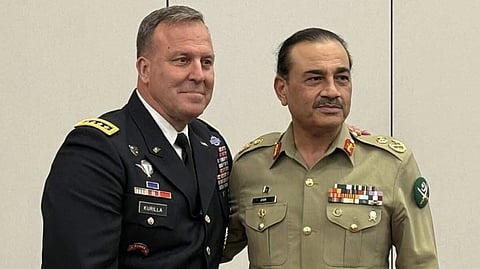

NEW DELHI: Nuclear sabre-rattling is Pakistan's "stock-in-trade", New Delhi said on Monday, in a strong response to Pakistan Army Chief Field Marshal Asim Munir's nuclear threat directed at India from the US soil.
India said Munir's remarks reinforced the well-held doubts about the integrity of nuclear command and control in Pakistan where the military is "hand-in-glove" with terrorist groups.
In a statement, the Ministry of External Affairs (MEA) said India has already made it clear that it will not give in to nuclear blackmail and that it will continue to take all steps necessary to safeguard national security.
It is also regrettable that these remarks should have been made from the soil of a friendly third country, the MEA said in an apparent message to the US.
In an address to Pakistani diaspora in Florida's Tampa, Munir reportedly made the nuclear threat in case his country faced an existential threat in a future war with India.
The Pakistani Army Chief also warned that Islamabad would destroy Indian infrastructure, if they hit water flow to Pakistan.
"We are a nuclear nation. If we think we are going down, we'll take half the world down with us," media reports quoted him as saying.
The Pakistan Army Chief's comments are part of a pattern in Pakistan as whenever the US supports the Pakistan military, they always show their true colours of aggression, government sources said.
It is a symptom that democracy does not exist in Pakistan and it is their military which controls the country, they said.
"Emboldened by reception and welcome by the US, the next step could possibly be a silent or open coup in Pakistan so that the Field Marshal becomes the President," said a source.
Munir is currently on a visit to the US, his second in two months.
Munir, reiterated his stance that Kashmir is the “jugular vein” of Pakistan and calling it “not an internal matter of India but an incomplete international agenda."
This echoed his earlier remarks made weeks before the Pahalgam attack, in which he asserted Pakistan would not forget the Kashmir issue. India has dismissed his comments, with the Ministry of External Affairs stating that Kashmir is a union territory of India and that Pakistan’s only link to it should be the vacation of illegally occupied territories.
Munir claimed Pakistan responded “resolutely and forcefully” in the recent conflict with India and warned that any Indian aggression would be met with a “befitting reply.”
Highlighting his second US visit in just over a month, Munir said it signaled a new dimension in Pakistan-US relations aimed at building constructive, sustainable ties. He expressed gratitude to Donald Trump, crediting his “strategic leadership” with preventing war between India and Pakistan and averting other global conflicts, though India maintains that cessation of hostilities was achieved through direct military talks without US mediation.
Munir also noted that a trade agreement with the US is expected to draw major investments and that Pakistan has made significant diplomatic gains. His June US trip included a rare five-day schedule and a private luncheon with Trump—an honour usually reserved for heads of state—which led to announcements of increased cooperation, including an oil deal.
In Tampa, Munir attended the retirement ceremony of outgoing US CENTCOM Commander General Michael E. Kurilla and the change-of-command ceremony for Admiral Brad Cooper, and he met Chairman Joint Chiefs of Staff General Dan Caine to discuss professional matters, inviting him to visit Pakistan. He also met defense chiefs from allied nations and urged the Pakistani diaspora to have faith in the country’s future and contribute to attracting investments, with attendees pledging continued support for Pakistan’s progress and development.
