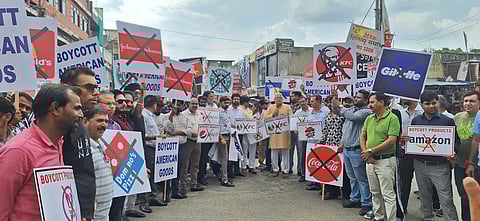

JAIPUR: Jaipur traders staged a strong protest against United States President Donald Trump’s decision to impose steep additional tariffs on Indian goods in Rajapark's main square.
Vendors from the city’s main market carried placards condemning the US and Trump, announcing a complete boycott of American products. In a symbolic act, they allegedly burned an effigy of Trump along with US-made goods, even setting fire to US dollar notes.
The Trump administration’s revised tariff policy has delivered a heavy blow to Rajasthan’s exporters. The move imposes an immediate 25% duty, with an additional 25% levy on the way, a combined 50% hit on key export sectors like gems and jewellery, handicrafts, and textiles, where Rajasthan holds a dominant share.
Ravi Nayyar, President of Rajapark Vyaapar Mandal, said, “Jaipur’s business organisations have asked all citizens to boycott US products, and we want to give a strong message that because of the arrogance of US President Donald Trump, irrational tariffs have been imposed on us.”
With ₹17,000 crore of the state’s annual exports dependent on the US market, exporters warn this reliance is turning into a liability. Finding new markets will take time, and the immediate risk is to the livelihoods of nearly seven lakh artisans and workers employed in US-focused export units. Industry bodies have urged the government to roll out urgent support measures.
Navinit Jhalani, coordinator of the Rajasthan Handicrafts Exporters Joint Forum, said uncertainty has gripped both US buyers and local exporters. “We have only 21 days, until 28 August, to ship goods to the US without the additional 25% penalty,” he explained. “With Raksha Bandhan and Independence Day holidays, meeting this deadline is near impossible. Orders ready after this date are being put on hold by American buyers.”
Jaipur, India’s gems and jewellery powerhouse, is staring at deep losses. Import duties had already risen from 5.5% to 15.5% earlier this year; the new hike will push many exporters to the brink.
Sanjay Kala, former president of the Jewellers Association, said the US accounts for Rs 11,000–Rs 12,000 crore of Rajasthan’s Rs 17,500 crore gems and jewellery exports, most from Jaipur. “Around 1.5 lakh people work in this sector in Jaipur, and up to 95% may feel the impact,” he warned.
Kala noted that while India now faces a 50% tariff, competitors like Turkey, Vietnam, Thailand, and the UAE enjoy lower rates of 10–20 per cent, making Indian products uncompetitive. “Some manufacturers are already considering shifting production abroad,” he said.
Jodhpur, a leading exporter of wooden furniture and metal handicrafts, sends Rs 2,500 crore worth of goods to the US annually, more than half its total exports. The tariff hike threatens the livelihood of nearly one lakh artisans and workers.
“With competitors like Turkey and Mexico facing just 10% tariffs, our products could be priced out of the market,” said Dr Bharat Dinesh, president of the Jodhpur Handicraft Exporters Association. “The Centre must act fast to safeguard MSMEs and open talks with the US.”
Bikaner’s famed wool industry, with 250 units producing 1–1.5 lakh kg of yarn daily, faces a severe blow. This yarn is used in carpets exported worldwide, especially to the US via Bhadohi. The 50% tariff threatens to snap this supply chain, impacting about one lakh people directly or indirectly linked to the sector.
Udaipur’s quartz industry, which supplies 40–45% of Rajasthan’s exports to the US in this category, will suffer as buyers turn to cheaper suppliers in Vietnam, Turkey, and Brazil. The city’s marble exporters, already hit by a slowdown, now face uncertainty over shipments worth Rs 100 crore annually.
Kota stone and sandstone exports worth Rs 200 crore annually could lose buyers to other markets as US costs rise. The Hadoti region’s coriander, dairy products, chemicals, and de-oiled cake exports are also at risk, potentially affecting Rs 250 crore in trade.
Rajiv Arora, president of the Federation of Rajasthan Exporters, urged the Centre to expand production-linked incentive schemes and provide targeted relief for affected sectors.
“If we don’t act fast, the economic and social fallout could be severe,” he said.
