
NEW DELHI: As geopolitical tensions escalate over India’s energy ties with Russia and new US tariffs on Indian goods, New Delhi is set to have high-level engagements with two of Washington’s chief strategic rivals, China and Russia, within a single week. These parallel diplomatic efforts highlight India’s need for a nuanced foreign policy calculus as it navigates a shifting global order.
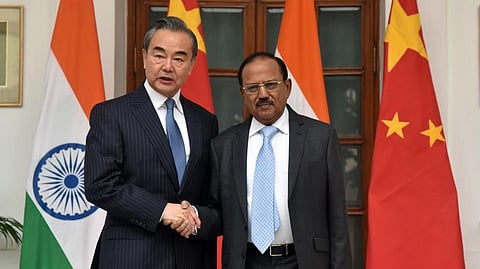
Chinese Foreign Minister Wang Yi is slated to visit India on August 18 for talks under the Special Representatives (SR) mechanism, a bilateral channel primarily aimed at managing and resolving the longstanding border dispute. National Security Advisor Ajit Doval will represent India. While the mechanism has been dormant in recent years due to post-Galwan tensions, this meeting is being viewed as a signal of intent from both sides to re-engage cautiously, but constructively. Wang is set to call on Prime Minister Narendra Modi as well.
Relations between New Delhi and Beijing have been severely strained since the 2020 Galwan Valley clashes in eastern Ladakh. Wang Yi’s visit may pave the way for a broader normalisation process and building of mutual trusts.
More significantly, it sets the stage for a possible meeting between Prime Minister Narendra Modi and Chinese President Xi Jinping at the Shanghai Cooperation Organisation (SCO) summit in Tianjin on August 31, Modi’s first visit to China in seven years.
This diplomatic opening comes against the backdrop of heightened friction with Washington. Earlier, the United States imposed an additional 25% tariff on a range of Indian exports, widely interpreted as punitive action over India’s continued purchase of Russian oil at discounted rates. The decision is seen as a marker of increasing limits of strategic convergence between India and the US, particularly when core interests diverge.
In this context, External Affairs Minister S Jaishankar’s scheduled visit to Moscow on August 20–21 assumes added significance. He will co-chair the annual meeting of the India-Russia Inter-Governmental Commission on Trade, Economic, Scientific and Cultural Cooperation (IRIGC-TEC) with Russian counterpart Sergey Lavrov. The commission serves as the primary platform for managing bilateral trade and energy cooperation.
Jaishankar’s visit follows National Security Adviser Ajit Doval’s quiet but high-profile meeting with President Vladimir Putin in Moscow last week. It is seen as a signal that India is doubling down on its strategic engagement with Russia even as Western pressure mounts on New Delhi.
Energy security is expected to dominate the agenda, alongside efforts to diversify bilateral trade and insulate it from secondary sanctions. Though India isn't cutting back on defence and strategic ties with the US, its back-to-back diplomacy with China and Russia reflects an effort to sustain strategic autonomy under mounting American pressure. For New Delhi, this might not be about choosing sides but about maintaining leverage across all axes of power.
