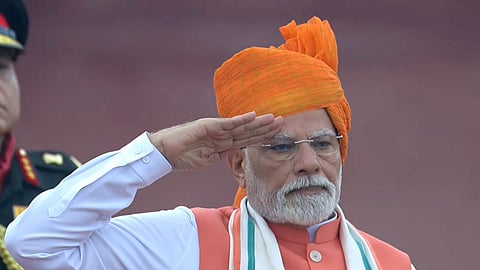

NEW DELHI: Prime Minister Narendra Modi has announced that the government will roll out next-generation Goods and Services Tax (GST) reforms by Diwali, pledging relief for households through lower taxes on daily-use items. Modi made the announcement in his Independence Day speech on Friday.
“The government will bring Next Generation GST reforms, which will bring down the tax burden on the common man. It will be a Diwali gift for you,” said Modi, ensuring that these reforms directly benefit citizens and stimulate economic activity.
Reacting to the Prime Minister’s announcement, the Ministry of Finance said the Centre has submitted a proposal to the Group of Ministers (GoM) set up by the GST Council, detailing reforms under three key pillars, structural changes, rate rationalisation and ease of living.
“The reforms are aimed at making essential goods more affordable, directly benefiting consumers while boosting consumption and economic activity. The move is expected to particularly help middle-income families and small businesses, while also simplifying the overall tax structure,” the Finance Ministry said in a social media post.
The announcement aligns with the Centre’s broader push to make the GST framework simpler, more stable and citizen-friendly, with an emphasis on enhancing ease of doing business and supporting inclusive growth.
The structural reforms will address the correction of inverted duty structures to align input and output tax rates, so that there is a reduction in the accumulation of input tax credit; resolve classification issues to streamline rate structures, minimise disputes, simplify compliance processes, and ensure greater equity and consistency across sectors; and provide long-term clarity on rates and policy direction to build industry confidence and support better business planning.
Rate rationalisation would aim at reducing taxes on common man items and aspirational goods; reducing slabs to two, standard and merit, with special rates only for a select few items.
The end of the compensation cess has allegedly created fiscal space, providing greater flexibility to rationalise and align tax rates within the GST framework for long-term sustainability.
As for ease of living, the aim is to simplify registration, filing of returns and claiming of refunds.
The GST Council, which has not met since December 2024, is likely to meet in September.
“It is expected that this Diwali items of mass consumption by the common man will be brought into the lower slab of 5% GST,” said Vivek Jalan, Partner, Tax Connect Advisory Services LLP.
Details of the proposed changes will be finalised in consultation with states through the GST Council in the coming weeks, with an aim to implement them ahead of the festive season.
The Finance Ministry confirmed that these proposals are being advanced in the spirit of cooperative federalism and will be implemented in close consultation with states. The GST Council is expected to deliberate on the GoM’s recommendations in its upcoming meeting, with efforts to roll out changes within the current financial year.
GST was rolled out eight years ago on 1 July 2017. As highlighted by the Prime Minister, after the completion of eight years, the time had come to review these changes. A committee has been formed for the review, and the states were consulted too, following which the government has readied new GST reforms.
