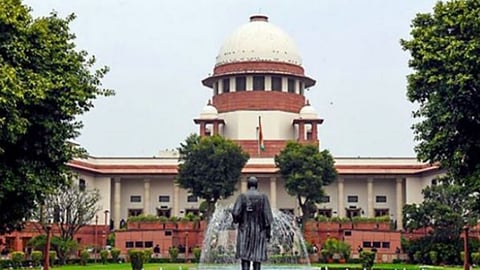

NEW DELHI: On the fourth day of hearings in the Presidential Reference case, the Supreme Court on Tuesday questioned the Centre on whether a Governor’s independent power to withhold a Bill could extend to Money Bills, thereby allowing such Bills to be delayed or withheld indefinitely.
In response, Solicitor General Tushar Mehta, representing the Centre, asserted that if a Governor withholds a Bill, it effectively lapses. He also challenged the Supreme Court’s earlier stance in the Tamil Nadu and Punjab Governor cases, which held that a withheld Bill must be returned to the Assembly for reconsideration. Mehta argued that prescribing a timeline for Governors and the President to act on Bills passed by State Legislatures undermines the discretionary powers conferred upon these constitutional authorities.
Senior advocate Harish Salve, appearing for the Maharashtra government, emphasised that only the Governor or President has the authority to grant assent to Bills, not the courts. He argued that mere delay in action by the Governor does not amount to constitutional failure, stating:
"It cannot be assumed that in every case where the Governor has not issued the declaration immediately or in a short period of time, the Governor is guilty of inactivity."
Salve further maintained that no time limits can be imposed on a Governor's actions: "He is not sitting in an ivory tower making decisions," he noted.
The BJP-led NDA-governed states, Maharashtra, Goa, Haryana, Chhattisgarh, and Puducherry, supported this view, contending that fixed timelines for constitutional authorities like Governors and the President contradict the discretionary powers enshrined in the Constitution.
Senior advocate Maninder Singh, representing Rajasthan, submitted that the matter raises substantial questions of law and should be referred to a larger Bench of at least five judges under Article 145(3). He also argued that assent to a Bill is a complete legislative act that should not be bound by any timeline.
Appearing for Puducherry, senior advocate Vinay Navare endorsed the Presidential Reference and insisted that the President and Governors must have full discretion to withhold assent, asserting that their role is “not an empty formality.”
Similarly, Additional Solicitor General Vikramjit Banerjee, for Goa, said that legislation cannot be completed without the Governor’s assent. He stressed that the Constitution does not allow for "deemed assent," and courts should not intrude into legislative functions.
Senior advocate Neeraj Kishan Kaul, representing Madhya Pradesh, questioned the need to send a Bill to the Governor at all if it were to be treated as a mere formality.
"He is not the representative of a political party, he, as the highest executive in the State, represents the people," Kaul argued.
For Chhattisgarh, senior advocate Mahesh Jethmalani stated that the Governor's discretion is essential to a functioning democracy and is not contrary to a responsible government. He pointed out that even the Constitution does not prescribe timelines for assent, except in limited cases such as Money Bills in Legislative Councils.
The arguments remain inconclusive and are scheduled to continue in the Supreme Court on Thursday, 28 August, when opposing parties are expected to present their submissions.
The five-judge Constitution Bench hearing the matter is led by Chief Justice of India (CJI) B R Gavai and includes Justices Surya Kant, Vikram Nath, P S Narasimha, and A S Chandurkar.
On 8 April, a two-judge Bench comprising Justices J B Pardiwala and R Mahadevan, in the case of State of Tamil Nadu vs Governor of Tamil Nadu, ruled that a Governor must act on Bills within three months if withholding assent or reserving the Bill, and within one month if the Bill is re-enacted. The same timeline was prescribed for the President when deciding on Bills referred by Governors.
Challenging this verdict, President Droupadi Murmu moved the Supreme Court on 13 May, raising 14 significant constitutional questions under the rarely invoked Article 143(1), which allows the President to seek the apex court’s advisory opinion on issues of public importance.
Among the key questions raised were:
What are the constitutional options available to a Governor when presented with a Bill under Article 200?
Is the Governor bound by the advice of the Council of Ministers in all such cases?
Is the Governor’s discretion under Article 200 subject to judicial review?
Does Article 361 bar judicial scrutiny of a Governor’s actions under Article 200?
Can the judiciary impose timelines or prescribe a manner for the Governor to exercise powers under Article 200 in the absence of constitutional stipulation?
The Supreme Court had on 22 July agreed to hear the Presidential Reference in detail, marking a significant constitutional development on the role and limits of gubernatorial powers in the Indian legislative process.