
CHANDIGARH: The flood situation remains dire across eight districts of Punjab, Gurdaspur, Pathankot, Amritsar, Hoshiarpur, Kapurthala, Tarn Taran, Ferozepur, and Fazilka, where the Ravi, Beas, and Sutlej rivers are in spate. Water levels at the Pong and Ranjit Sagar dams have already surpassed maximum capacity, while Bhakra Dam is only nine feet away from reaching its limit. Adding to the crisis, three floodgates at the Madhopur headworks have broken, resulting in large inflows and controlled but high-volume outflows that are worsening the flooding downstream.
The Madhopur headworks, located on the Ravi River along the Punjab-Jammu and Kashmir border in Pathankot district, suffered severe damage as three of its floodgates were washed away by gushing waters. Consequently, water released from the Ranjit Sagar Dam can no longer be stopped, escalating the situation.
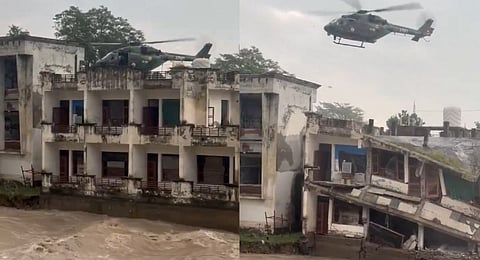
In a second rescue operation by an army helicopter, nearly 50 stranded staff members at the Madhopur headworks were successfully evacuated.
Water levels at major dams continue to rise precariously. At Bhakra Dam, the level was recorded at 1671.68 feet on Wednesday morning, just nine feet below its maximum of 1680 feet, with an equal inflow and outflow of 43,800 cusecs. Pong Dam, with a maximum level of 1,390 feet, had crossed the limit at 1,393.13 feet, with an inflow of 1.24 lakh cusecs and an outflow of 94,845 cusecs. At Ranjit Sagar Dam, the water level stood at 526.24 metres, dangerously close to its 527.91-metre limit. Shahpur Kandi Dam saw levels rise to 398.90 metres against its maximum of 405 metres, releasing 1.41 lakh cusecs.
The Ravi River surged to 4.60 lakh cusecs early Wednesday, flooding vast areas in Gurdaspur, Pathankot, and Amritsar. The water level in Ranjit Sagar Dam crossed the danger mark, necessitating controlled releases of water. On Tuesday, nearly 1.95 lakh cusecs of water had already been discharged. Controlled releases from Bhakra and Pong dams are also ongoing.
Catchment areas in Himachal Pradesh, including Mandi—one of the worst-hit regions, have experienced heavy rainfall and cloudbursts since early August. This has led to massive inflows into the Beas River, which feeds into Pong Dam, resulting in rising reservoir levels.
In Amritsar’s Ajnala and Ramdass regions, around 20 villages have been severely affected due to the Ravi’s overflow. A breach in the Dhussi Bandh led to flooding in numerous villages, with Ghonewal and Machhiwala the worst hit.
The Punjab government has issued warnings to residents in vulnerable villages, urging them to prepare for possible evacuation. Relief camps have been established across the affected districts, one in Kapurthala, six in Ferozepur, and five in Hoshiarpur. In Fazilka, floods have destroyed 36,435 acres of land and damaged or collapsed 270 houses.
In a separate high-risk rescue operation, 22 CRPF personnel and three civilians were airlifted from a flooded village by an Army helicopter, minutes before the building they were sheltering in collapsed. A defence spokesperson praised the swift operation carried out by Army Aviation at 6 am on Wednesday, highlighting the army’s unwavering commitment and coordination with local authorities to prevent loss of life.
Punjab Chief Minister Bhagwant Singh Mann has directed all cabinet ministers to remain on the ground until the situation stabilises. He announced the deployment of the state government’s helicopter for rescue and relief purposes. “This helicopter belongs to the people who gave us a mandate, and it will now serve them in their hour of need,” said Mann.
During his visit to flood-affected areas in Gurdaspur, Mann acknowledged the urgent need for evacuation from marooned villages. He stated that while he would continue travelling by road, the helicopter would be exclusively used to support flood-hit communities.
Flood control rooms have been set up in all districts, and the state government has committed to fully compensating those who have suffered losses due to the heavy and incessant rainfall. A special Girdawari (revenue survey) has been ordered to assess damages fairly, ensuring affected families receive proper compensation.
Mann also announced the formation of a state-level flood management committee and the establishment of a central flood control room in Jalandhar.
However, the opposition has strongly criticised the government’s response. Leader of Opposition Partap Singh Bajwa said, “I saw the pain and destruction with my own eyes. Farmlands are submerged, homes destroyed, and thousands displaced. Yet, the government is busy issuing press releases instead of delivering actual relief.”
He accused the Aam Aadmi Party-led government of boasting about spending ₹230 crore on flood prevention, including desilting 4,766 km of waterways, constructing over a thousand check dams, planting bamboo saplings, and stockpiling sandbags. “When the floods came, these measures collapsed like a house of cards. Villages are drowning, and farmers have been left helpless,” Bajwa remarked.
He also criticised Water Resources Minister Barinder Kumar Goyal for his claims of ₹276 crore spent on 1,220 projects and high-tech SCADA systems, stating, “I saw no protection or preparedness on the ground—only hollow boasts meant to mislead the people.”
Bajwa added that hundreds of villages across Pathankot, Gurdaspur, and Kapurthala remain cut off or submerged. In Kapurthala alone, 8,000 people have been displaced and thousands of acres of paddy crops destroyed. “This is not merely a natural disaster—it is a man-made failure due to the negligence of the Mann government,” he asserted.
The Indian Air Force helicopter successfully evacuated 46 stranded civilians from the Madhopur headworks, and over 750 kilograms of essential relief material was air-dropped to flood-hit communities. Additionally, in a high-stakes operation, 38 Army and 10 BSF personnel were rescued from the severely inundated Dera Baba Nanak region.
Bajwa has demanded that the government immediately release ₹51,000 per acre for farmers who have suffered total crop loss and ₹31,000 per acre for partial damage. He further urged that 60 per cent of compensation be disbursed without delay, along with timely aid for livestock and property losses. “Enough of hollow announcements—Punjab’s people need real support today,” he concluded.
