
A coalition of environmentalists has made urgent appeals to the Union government, Rajasthan government and Tiger Conservation Authority, voicing their concerns over the proposal to alter the boundaries of the Sariska Tiger Reserve (STR) in order to facilitate mining activities in the Aravalli hills. They emphasized that this decision could set a troubling precedent and have a negative impact on wildlife conservation efforts across the country.
In early July, India’s wildlife authority approved changes to the boundaries of the STR as part of a conservation plan that also accommodates mining activities. The adjustment affects both the Critical Tiger Habitat (CTH) and the buffer zone, aiming to enhance wildlife conservation while taking into account the development needs of nearby regions.
Experts warn that if the proposed rationalization plan is implemented, it could have disastrous consequences for the ecologically sensitive Aravalli region.
The environmental group "People for Aravallis" submitted representations to the Ministry of Environment, Forest and Climate Change, the Chief Minister of Rajasthan, and the National Tiger Conservation Authority (NTCA), expressing concerns about the recent proposal to redraw the boundaries of the Sariska Tiger Reserve.
According to the group, the decision to redraw the boundaries aims to allow the reopening of at least 50 marble, dolomite, limestone, and masonry mines that were closed following a previous Supreme Court order. Activists argue that this could set a dangerous precedent across the country, legitimizing similar illegal activities.
“The group submitted three representations on July 14 to India’s Environment Minister, the Additional Director General (Project Tiger), and the Chief Minister of Rajasthan, urging them to abandon the proposal to redraw the boundaries of the STR, as it is flawed from both an ecological and legal standpoint,” said Kay Nair, Co-Founder of People for Aravallis.
“A significant concern in the proposed plan is its potential to reopen around 50 marble, dolomite, limestone, and masonry stone mines near the new boundaries of the reserve,” Nair added.
As per the guidelines for declaration of eco-sensitive zones around protected areas, an area of up to 10 km radius may be included as a ‘shock absorber’. The buffer zone is currently established to be a radius of 1 km around the boundaries of STR.
Uma Shanker Singh, retired Principal Chief Conservator of Forest from Uttar Pradesh, who is one of the 37 retired IFS officers who wrote to the Prime Minister in February 2025 highlighting the damage to the Aravalli range as a result of mining and other activities, urged the government at the Centre and in the four Aravalli states to take urgent steps to protect Aravalli.
“Allowing mining in an eco-sensitive zone such as Sariska can have serious long-term harmful impacts on its flora & fauna. Blasting and mining activities hugely put the wildlife at risk,” said Singh.
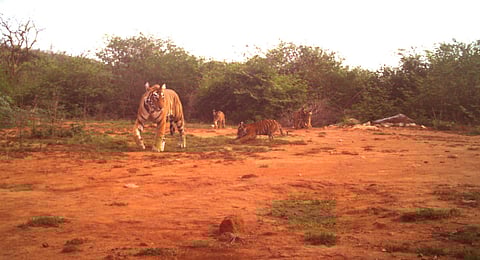
In 2004, poaching resulted in the killing of 28 tigers in Sariska, and their number was reduced to zero. Later, tigers were relocated to Sariska from Ranthambore. After many years of successful conservation efforts, the tiger count in Sariska stands at a historic high of 49.
In 1992, the government regulated development activities in the Aravallis spanning across the Gurgaon and Alwar districts of Haryana and Rajasthan through notifications. Later, in 2018, the Centrally Empowered Committee report had revealed that mining had razed 31 Aravalli hills of Alwar district to the ground.
"The government and the Supreme Court must scrap the ecologically disastrous proposal to redraw boundaries of Sariska which is not in the interest of protecting our national animal and instead benefits the miners," said Dr Rajendra Singh, a water conservationist from Rajasthan.
