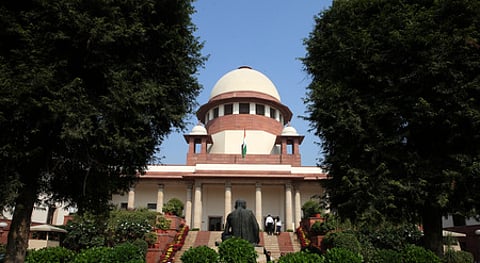

NEW DELHI: In a significant development, the Supreme Court on Wednesday directed the Delhi government to issue a fresh notification declaring the historic Lodhi-era monument "Gumti of Shaikh Ali" as a protected monument under the law.
The two-judge bench of the apex court, comprising Justice Sudhanshu Dhulia and Justice Ahsanuddin Amanullah, passed the direction while hearing an appeal filed by Defence Colony resident Rajeev Suri.
Suri had sought the court’s intervention to declare the Gumti a protected monument under the Ancient Monuments and Archaeological Sites and Remains Act, 1958 (AMASR Act), after the Delhi High Court dismissed his petition.
During the hearing, the bench examined a report submitted by the Delhi government, which included a previously issued notification. However, the court observed that the notification was not “happily worded” and thus required reissuance.
“Let the notification (to declare the monument as a protected one under the law) be re-issued by the Delhi government,” the bench directed.
Emphasising the need to protect the site, the court made it clear that there should be no illegal structures or encroachments around the area. It instructed the relevant authorities to demolish any unauthorised structures present within the monument site.
A court commissioner has been directed to visit and inspect the area and update the bench on the progress of actions undertaken in compliance with its orders.
The bench also instructed the Archaeology Department and other concerned agencies to prepare and implement a plan to preserve and beautify the monument and its surroundings.
Criticising the Municipal Corporation of Delhi (MCD) for continuing to operate an office in close proximity to the monument, the court ordered it to vacate the premises within 48 hours, “lock, stock, and barrel”.
The apex court had earlier expressed its displeasure over the Defence Colony Residents Welfare Association (RWA), which had unauthorisedly occupied the "Gumti of Shaikh Ali" for more than six decades.
The court directed the RWA to pay Rs 40 lakh as compensation for its illegal occupation of the tomb since the 1960s. The RWA had attempted to justify its occupation by claiming it was safeguarding the monument from anti-social elements.
The Supreme Court, however, refused to waive the penalty and made it clear that such unauthorised occupation, irrespective of intent, could not be condoned.