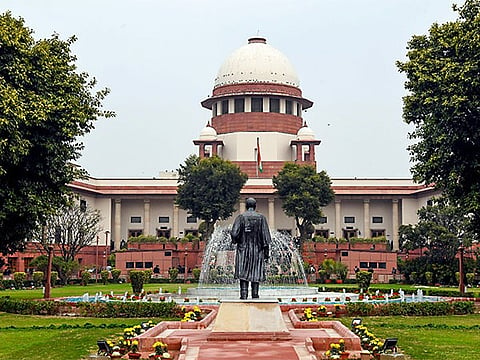

NEW DELHI: The Supreme Court on July 23 agreed to hear next week a plea filed by a lawyer, seeking quashing of the provisional No Objection Certificates (NOC) issued by district collectors of Angul, Nayagarh, Boudh and Cuttack for development works inside and around the Satkosia Tiger Reserve.
Advocate Gaurav Kumar Bansal mentioned the matter before a three-judge bench of the top court, headed by the CJI, B R Gavai, who agreed to list and hear the matter next week.
Bansal -- raising serious concerns over the alleged proposed constructions inside the Satkosia Tiger Reserve in Odisha -- questioned the directions passed by the district collectors, as to how the officers had issued such permissions for the construction of an eco-tourism spot.
The Bench also comprised Justices K Vinod Chandran and Joymalya Bagchi -- besides the CJI -- said that they would take it up for hearing next week.
Bansal, in his plea, a copy accessed by TNIE, said that the series of actions undertaken by the State of Odisha poses an imminent and irreparable threat to the ecological integrity and statutory sanctity of the Satkosia Tiger Reserve, an ecologically fragile and legally protected area.
"Critical safeguards under forest, wildlife, and environmental law are being actively undermined by state agencies through unauthorised constructions, ultra vires approvals, and a tourism-led development model that disregards established conservation mandates," he highlighted.
Bansal said that the Satkosia Tiger Reserve, notified in 2007, is a critical ecological and legally protected area in Odisha, spanning 1,136.70 sq. km.
It includes the Satkosia Gorge Sanctuary and Baisipalli Wildlife Sanctuary, divided by the Mahanadi River. The reserve is ecologically irreplaceable, hosting endangered species like Asian Elephants, Gharials, Muggers, and diverse flora and fauna.
"Recognised as a Ramsar site, it supports rare aquatic and avian biodiversity. In 2016, a fishing ban was imposed to protect Gharials, demonstrating its fragile ecosystem. However, the absence of a notified Eco-Sensitive Zone (ESZ) leaves it vulnerable to external threats," he added in his plea.
Bansal further argued the order passed by the DCs was without jurisdiction and in violation of the Wildlife (Protection) Act, 1972.
The National Tiger Conservation Authority (NTCA) mandated a minimum 1-km ESZ around Tiger Reserves in 2018, but Odisha's draft ESZ proposal for Satkosia includes stretches with "zero" buffer zones, notably near the Satkosia Gorge, endangering aquatic species.
"The proposal also permits commercial hotels and resorts, contradicting conservation goals. Additionally, a High-Level Bridge over the Mahanadi River is being planned without environmental clearances, exploiting the lack of an ESZ. DCs have illegally issued NOCs for tourism infrastructure within the reserve, bypassing statutory authorities like the Chief Wildlife Warden and NTCA," said the plea.
Accusing the Odisha government's actions as a deliberate shift from conservation to commercialisation, Bansal said that the State's approach violates NTCA's 2012 guidelines and MoEFCC's 2021 eco-tourism norms, which emphasise community-based, low-impact tourism and prohibit permanent constructions.
News reports confirm Odisha's prioritisation of tourism over conservation, prompting NTCA scrutiny. The petitioner further submits that there are multiple large-scale and systemic issues affecting the ecological and legal integrity of Satkosia Tiger Reserve, which require independent attention and urgent consideration by this court.
