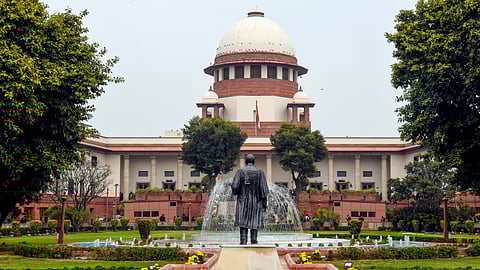

NEW DELHI: The Supreme Court on Thursday agreed to hear cases related to Rohingyas as to whether they are refugees or illegal entrants, and whether they can be detained indefinitely in India.
The apex court, which was hearing a batch of petitions on the deportation and living conditions of Rohingya refugees in the country, identified the main issues and decided to segregate them for adjudication later.
A three-judge bench of the Supreme Court, comprising Justice Surya Kant, Justice Dipankar Datta, and Justice N. Kotiswar Singh, while recording the submissions of the petitioners and others, observed that once the key issues are decided, other factors might be consequential.
The Court segregated the cases for convenience and passed an order to hear the matter based on these issues.
“Are Rohingyas entitled to be declared as refugees, and if so, what protections or rights are they entitled to? If they are not refugees but illegal entrants, are the Union government’s actions in deporting them justified? Even if they are held to be illegal entrants, can they be detained indefinitely, or are they entitled to be released on bail under conditions the Court deem fit to be imposed? Whether the Rohingyas who are not detained and living in refugee camps, have been provided basic amenities such as sanitation, drinking water, and education, etc. (in conformity with Article 21)?”
The Court also said it would examine whether, if the Rohingyas are deemed illegal entrants, the Government of India and the States are obligated to deport them in accordance with the law.
It, however, clarified that the issues that arose in Batch II will be dealt with separately by the Supreme Court.
The apex court, however, did not fix any particular date to hear the issues.
The batch of petitions filed in the Supreme Court raised many questions, including the deportation of illegal Rohingya immigrants and their living conditions, ranging from health, sanitation, access to clean water, habitation conditions, access to education, etc.
The Court added that rather than issuing interlocutory orders, it would be better to take up these matters and decide if they have a right to remain in the country and that it should be acknowledged.
"If they don't have a right to stay here, then they will follow the procedure and deport as per law," the court pointed out.
Justice Datta highlighted that "they (Rohingyas) are all foreigners and if they are covered by the Foreigners' Act or not will also be decided."
Senior advocate Colin Gonsalves, appearing for the NGO Rohingya Human Rights Initiative, said one Rajubala’s case can also be treated as a Rohingya matter.
Her husband has been detained in Assam as a foreigner along with 30 other Rohingyas. Advocate Prashant Bhushan argued that there were matters regarding the prolonged detention of people declared as foreigners in Assam.
"The core issue, however, is whether Rohingyas are to be treated as refugees or illegal migrants. The commonality is that they relate to the interpretation to the Foreigner’s Act," he contended.