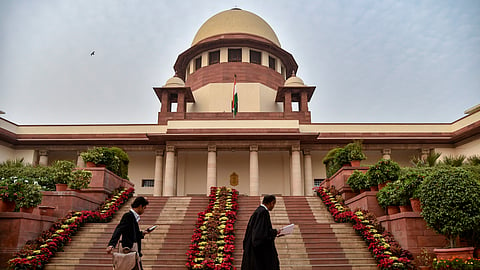

The Supreme Court has rejected the PIL filed by a lawyer seeking directions to all states & Union territories to formulate and implement a robust system to ensure the loading capacity of every passenger bus is mandatorily checked at its departure point and en route to its terminal point.
The petition filed by advocate Sangam Lal Pandey before the apex court said the passenger buses operated under the aegis of state transport departments and private operators routinely engage in overloading by placing goods (e.g., agricultural produce, commercial items) on bus roofs and cramming passengers and cargo beyond the sanctioned seating and weight capacity.
The top court's two-judge bench, headed by Chief Justice B R Gavai and including K Vinod Chandran, rejected the PIL, noting that since the subject matter pertains to a policy decision falling within the domain of the government, it is not inclined to entertain the writ petition.
There are several transporters running passenger buses from New Delhi to other parts of India, viz; R.S. Yadav, Gola Bus Service, PTC-Skybus, BT Travels, Zingbus, Laxmi Holidays, Intrcity Smart Bus, Raj Kalpna Travels PVt. Ltd., Fouji Travels, Mannat Holidays, etc. who are wilfully flouting the norms of Motor Transport Workers Act, 1961 and loading beyond capacity, thus causing damage to the roads and going against the safety of passengers, stated the plea of Pandey, exclusively accessed by TNIE.
"In states like Uttar Pradesh, where 1,337 bus deaths occurred in 2022 (28.9% of national total), overloading claims 400-500 lives yearly, underscoring the urgent need for protective measures to safeguard vulnerable citizens. This court in Municipal Corporation of Delhi versus Gurnam Kaur (1989) directed authorities to take preventive measures against foreseeable harm," said Pandey.
"Overloading's role in accidents (e.g., 36 deaths in Uttarakhand, 2024) is well-documented, yet the respondents rely on post-accident penalties rather than preemptive checks. The pervasive overloading of buses, causing thousands of deaths (e.g., 22,442 from 2018-2021), constitutes a systemic failure affecting millions, warranting this court's intervention," added the plea.
Pandey in his plea alleged that there was widespread public harm due to the state inaction, which resulted in non-compliance with the Motor Vehicles Act, 1988, and Central Motor Vehicles Rules, 1989.
"The absence of loading checks at bus terminals, despite technological feasibility (e.g., weigh-in-motion systems), reflects a failure to protect public safety, necessitating a nationwide directive. The failure of the respondents -- all the states and UTs -- to curb overloading, despite its known deadly consequences, is arbitrary and discriminatory, infringing Article 14 (Guarantee of equality) of the Indian Constitution," he said.
"The top court in the case of E.P. Royappa versus State of Tamil Nadu (1974) held that arbitrariness by public authorities violates equality. While other transport sectors (e.g., trucks) face stricter oversight, passenger buses escape scrutiny, with 828-2,073 deaths annually linked to overloading (2023 estimate). This selective inaction disproportionately endangers bus passengers, justifying judicial directions for uniform enforcement," said Pandey.
"Overloading increases fuel consumption by 15-20% (IIT Delhi, 2022 study), leading to higher emissions of CO2 and particulate matter, violating the right to a clean environment under Article 21," said the plea.
The petitioner highlighted that overloaded buses exacerbate air pollution, contributing to severe AQI levels in cities, yet the respondents have failed to implement loading checks, breaching the Air (Prevention and Control of Pollution) Act, 1981, and necessitating systemic reform.
Pandey in his petition clarified that the SC had in its earlier directions held that the state has a constitutional duty to prevent avoidable deaths, including those caused by unsafe transport conditions. "Overloading causes hundreds of deaths monthly -- estimated at 72-180 in 2025 (based on MoRTH trends) -- due to increased accident risks, as seen in the November 2024 Uttarakhand crash (36 deaths). The respondents' failure to enforce loading norms has led to preventable loss of life, necessitating judicial intervention to protect citizens," said the plea of Pandey.
