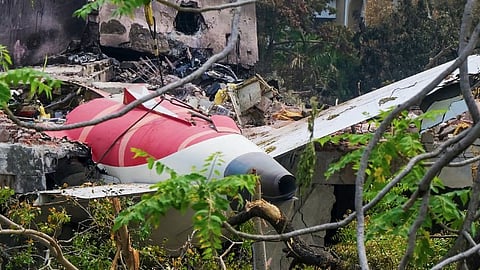

NEW DELHI: A two judge bench of Supreme Court is scheduled to hear writ petitions filed by Pushkaraj Sabharwal, father of late Captain Sumeet Sabharwal, who served as the Pilot-in-Command of the Air India flight which crashed in Ahmedabad, and the Federation of Indian Pilots (FIP) on November 7 seeking direction for the constitution of a panel for a judicially monitored probe into the horrific accident.
According to the causelist, a two-judge bench of the top court, headed by Justice Surya Kant, is likely to hear the pleas of Pushkaraj and FIP.
A writ petition running into 267 pages was filed on October 10 in the Supreme Court against the Union of India, the Directorate General of Civil Aviation, and the Director General of the Aircraft Accident Investigation Bureau (AAIB).
TNIE is the first Newspaper to report on October 16 that Pankaj Sabharwal and FIP had moved the apex court seeking direction for the constitution of a panel for a judicially monitored probe into the horrific accident.
88-year-old Sabharwal, a resident of Mumbai, is the first petitioner while the FIP is the second petitioner. They have requested the committee be headed by a retired SC court judge, along with independent experts from the aviation industry to ensure a fair, transparent and technically sound probe.
The Boeing 787-8 crash on June 12 resulted in the death of 260 people. The preliminary report released on July 12 by the Aircraft Accidents Investigation Board (AAIB), came in for massive criticism from pilot bodies and the families of the victims as it held 'human error' on the part of the cockpit crew responsible for the mishap.
The petitioners submitted that the AAIB report was "profoundly flawed." The investigation team had predominantly focused on the deceased pilots, who are no longer able to defend themselves, while failing to examine more plausible technical and procedural causes of the crash, they said.
"Selective disclosure against crew impedes root cause discovery and threatens future flight safety, calling for a neutral judicial lens," it added.
The report contains perversity and critical inconsistencies, they charged, adding that it lacked credibility and transparency. The deployment of the emergency generator, the Ram Air Turbine (RAT), before the crash is a direct indicator of an electrical or digital malfunction and contradicts the report’s inference that pilot actions initiated power loss.
"Yet, the investigation fails to provide time-stamped correlation between RAT deployment and crew inputs, and ignores the possibility that faults in the Common Core System (CCS), integrating avionics, flight controls, power distribution, and software, may have triggered the sequence of failures. The omission of this line of inquiry demonstrates bias and technical incompleteness," the petitioners charged.
The petition pointed out that the report had claimed that both fuel control switches moved from RUN to CUTOFF within one second and reverted shortly thereafter. "Such near-synchronised manual actuation is implausible under take-off conditions, especially if the RAT had already deployed before any crew action. This strongly suggests an automatic or corrupted digital command, not human intervention," the petition stated.
To treat this as a deliberate pilot error, without first excluding electronic malfunction, is procedurally unjust and logically unsound. It reverses causation, blaming the pilots for what could be a symptom of system failure rather than its trigger, they added.
