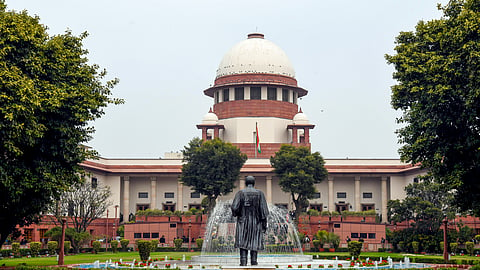

NEW DELHI: The Supreme Court on Thursday said that no timeline can be prescribed or imposed by courts for the grant of assent by the Governor or the President, but at the same time made it clear that constitutional authorities cannot sit over bills passed by state legislatures indefinitely.
“Articles 200 and 201 of the Constitution are framed to allow elasticity. The imposition of a timeline is strictly contrary to the Constitution… The concept of deemed assent is against the spirit of the Constitution and the doctrine of separation of powers,” a five-judge Constitution Bench led by Chief Justice of India B R Gavai said.
The court, while examining the powers and duties of the Governor, added that governors do not have unfettered power to sit indefinitely over bills passed by state assemblies.
The verdict was delivered on President Droupadi Murmu’s reference seeking the Supreme Court’s opinion on whether timelines can be imposed on Governors and the President for granting assent to state bills.
The bench clarified that if there is a prolonged or unexplained delay by the Governor that frustrates the legislative process, the court can exercise a limited power of judicial review and direct the Governor to decide within a reasonable, time-bound period, without commenting on the merits of the bill.
The apex court also held that the discharge of functions by the Governor or the President is not justiciable, and judicial review can be invoked only when the bill becomes law.
It further said the President is not bound to seek review when a bill is reserved by the Governor under Article 200, though the President may do so under extraneous considerations.
The court observed that when the Governor chooses not to act, constitutional courts can intervene. “We can issue a limited direction to the Governor to act without observing anything on merit,” the bench said.
While stating that the Governor cannot be made personally liable for his decisions, the court said constitutional courts can scrutinise such decisions. “In India’s cooperative federalism, Governors must adopt a dialogue process to iron out differences with the House over a Bill and not adopt an obstructionist approach,” the bench remarked.
The court upheld the Union government’s submission that the Governor has discretion under Article 200 and need not act solely on the aid and advice of the Cabinet while assenting to bills. It added that if the Governor withholds assent, the bill must be sent back to the legislature with comments.
The bench explained that the Governor has three constitutional options under Article 200: to assent, to reserve the bill for the President, or to withhold assent and return it with comments. The third option is not available for Money Bills.
It emphasised that the Governor enjoys discretion in choosing among the three options and that his decision cannot be subjected to merits review. However, in cases of prolonged, unexplained inaction, courts may issue a limited mandamus directing the Governor to act.
The judges underscored that constitutional authorities function like interdependent cogs in a clock, with checks and balances essential to prevent paralysis. “Such a constitutional scheme abhors inaction… Our constitutional scheme works only if it is worked,” the bench said.
The bench also clarified that the Governor is not a mere “rubber stamp” in the legislative process. But where he chooses not to initiate the constitutionally envisioned dialogue, courts may intervene to prevent the legislative process from being frustrated.
The bench had reserved its verdict on September 11 after a 10-day marathon hearing involving the Centre, several states, political leaders, parties and other respondents.
Earlier, on April 8, a two-judge bench had ruled that the Governor must act within three months if withholding assent or reserving a bill, and within one month when a bill is reenacted. It had also directed the President to decide on bills reserved for her consideration within three months.
President Murmu subsequently invoked the rarely used Article 143(1) to seek the Supreme Court’s opinion, raising 14 questions of constitutional significance.
During arguments, Solicitor General Tushar Mehta urged the court to modify the April 8 ruling, contending that the judiciary cannot impose timelines on the Governor or the President. While acknowledging that Governors cannot sit on bills endlessly, he argued that courts cannot issue mandamus to constitutional authorities vested with discretion.
States including Tamil Nadu, Kerala, Telangana, Andhra Pradesh and Karnataka opposed the presidential reference, arguing that the April 8 ruling should stand.
Among the 14 questions referred by the President, the most significant were:
What are the constitutional options before a Governor when a Bill is presented under Article 200 of the Constitution of India?
Is the Governor bound by the aid and advice tendered by the Council of Ministers while exercising all options available under Article 200?
Is the exercise of constitutional discretion by the Governor under Article 200 justiciable?
Is Article 361 an absolute bar to judicial review of a Governor’s actions under Article 200?
In the absence of a constitutionally prescribed time limit, can timelines be imposed and the manner of exercise of powers under Article 200 be prescribed through judicial orders?
